What Is a 2 Plus 1 Road? Meaning, Rules & Irish Context
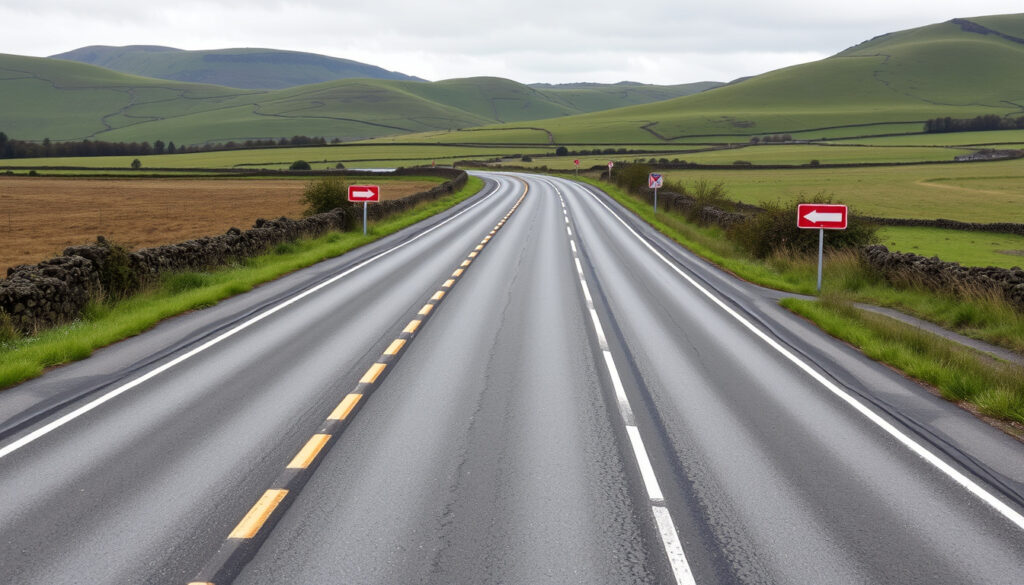
If you have ever sat behind a tractor on a narrow Irish road, the idea of a 2 plus 1 road starts to sound appealing. The layout gives one direction two lanes and the other direction one, and the side with the extra lane alternates in controlled stretches (Road Safety Authority (Ireland’s road safety agency), Rules of the Road). Once you understand that rhythm, the overtaking rules, the road markings, and the Irish driving-test questions all fall into line.
Lane layout: 2 lanes in one direction, 1 in the other · Irish road standard: Type 3, commonly called 2+1 · Safety reference: Sweden has used 2+1 roads extensively · Carriageway class: Single carriageway with an added overtaking lane
Quick snapshot
- A 2+1 road has two lanes in one direction and one lane in the opposite direction (Road Safety Authority (Ireland’s road safety agency)).
- The two-lane section exists to provide a safer overtaking opportunity (Transport Infrastructure Ireland (national roads authority)).
- The two-lane side alternates, so no direction keeps permanent priority (Road Safety Authority (Ireland’s road safety agency)).
- The exact date when the first Irish 2+1 road opened.
- Which specific Irish routes currently use a 2+1 layout.
- Whether 2+1 road is a formal legal definition in Irish road law.
- By 2004, Sweden had used 2+1 roads extensively, according to Independent.ie.
- April 2004: Independent.ie reported Irish drivers getting an extra overtaking lane (Independent.ie).
- 2007: road-enthusiast discussion described 2+1 as cheaper than a 2+2 conversion. (Independent.ie)
- Overtake only on the two-lane side.
- Return to the left lane after passing.
- Treat the one-lane section as a no-overtake zone.
Key facts at a glance
Eight details, one pattern: a 2+1 road is a single carriageway that hands a passing lane to each direction in turn — not a motorway and not a dual carriageway.
| Fact | Detail |
|---|---|
| Road type | Single carriageway with a 2+1 lane arrangement |
| Total lanes | 3 |
| Direction split | 2 lanes in one direction, 1 lane in the other |
| Overtaking side | Alternates between directions |
| Section length | Roughly 2 km before the two-lane side switches, per the RSA’s Rules of the Road |
| Central separation | Continuous safety barrier in the proposed Irish design, per the TII pilot programme |
| Not the same as | A dual carriageway or a 2+2 road |
| Legal overtaking rule | No overtaking unless the road ahead is clear and the move is safe |
Why this matters: before studying overtaking rules, pin down what the road actually is. Call a 2+1 road a dual carriageway and you will overestimate its space; call it a two-lane road and you will underestimate its danger.
What is a 2 plus 1 road in Ireland?
The Road Safety Authority’s Rules of the Road, the official Irish driver handbook, defines a 2+1 road in one line: two traffic lanes run in one direction and one lane runs in the opposite direction (Road Safety Authority (Ireland’s road safety agency)). The interesting part is that the side with two lanes is not fixed. It switches, and the switch is what makes the road type useful.
How does a 2+1 road work?
- The two-lane and one-lane sections alternate at roughly two-kilometre intervals (Road Safety Authority, Rules of the Road).
- A central safety barrier separates opposing traffic streams in the proposed Irish design (Transport Infrastructure Ireland, 2 Plus 1 Road Pilot Programme).
The alternation is the safety mechanism. Drivers get a short, dedicated passing window, and then the advantage flips to the opposite direction. No one has to gamble on a gap in oncoming traffic.
What is the Irish name for this road type?
- Irish road-standards discussion groups the layout as Type 3, commonly called 2+1.
- A 2+2 road, with two lanes in each direction, is classed as a dual carriageway under that same discussion.
Independent.ie reported in April 2004 that Irish drivers were getting an extra overtaking lane on 2+1 roads, a layout Sweden had already used extensively. The idea, in other words, is not new — it was framed as a safety upgrade long before it became a driving-test talking point.
The implication: a 2+1 road is a controlled overtaking tool, not a miniature motorway. The barrier, the alternating lane, and the road markings all work to stop drivers from improvising on the one-lane side.
What is a two-lane road?
The phrase “two-lane road” confuses people because of the number. In everyday driving language, a two-lane road has one lane for each direction of travel — the standard Irish rural road, with no central separation and very few legal passing places.
How many lanes does a 2+1 road have?
- A 2+1 road always has three lanes in total — that is what the name means.
- “Two lanes” refers to the direction that gets the passing side, not the whole road.
So a 2+1 road is not a two-lane road with a fancy sign. It is a three-lane road where the extra lane moves between directions.
Is a two-lane road the same as a 2+1 road?
- No — a two-lane road has one lane each way and almost no legal passing room.
- A 2+1 road has a third lane that appears and disappears in alternating sections.
Keep the two straight and the rest of the rules follow: 2+1 is about the total lane count; two-lane is about the basic layout.
Why this matters: in an Irish driving test, “I thought it was just a two-lane road” will not help if the examiner sees you pull out on a 2+1 road without using the designated passing section.
What is a single carriageway?
A single carriageway is the most common road in Ireland: one continuous road surface shared by traffic travelling in both directions. Overtaking on a single carriageway means moving into the path of oncoming traffic, which is why it is the most dangerous overtake a driver can attempt.
How does a 2+1 road fit into the single carriageway category?
- A 2+1 road is a single carriageway with an extra overtaking lane added.
- It is not a dual carriageway, because opposing traffic still shares the same road space — separated by a barrier in the pilot design, but not split into separate carriageways.
- The two-lane side alternates, so both directions get a fair share of passing opportunities.
The Transport Infrastructure Ireland pilot programme frames the two-lane section as a place where a safer overtaking opportunity is provided, rather than a permanent right to pass. That wording matters: the road gives you the chance, and the markings tell you when.
What is the difference between a single carriageway and a dual carriageway?
- Single carriageway: one road surface for both directions.
- Dual carriageway: separate carriageways for opposing traffic, usually divided by a central reservation.
- 2+1 roads sit in the first group, despite having three lanes.
The distinction matters for speed and overtaking rules. On a dual carriageway the central reservation cannot be crossed; on a 2+1 road the barrier enforces the same idea in a cheaper format.
The trade-off: 2+1 roads borrow the visual language of a dual carriageway — barrier, controlled gaps, no crossing — but most of the route stays an ordinary single carriageway, which keeps the cost well below a full 2+2 conversion.
Where may a driver overtake on a 2-plus-1 road?
The rule on a 2+1 road is simple: overtake only where the road hands you the extra lane. On the one-lane section you wait; on the two-lane section you pass.
Can you overtake in the one-lane section of a 2+1 road?
- No — on the one-lane section, a driver behind a slow vehicle must wait until the next two-lane section (Transport Infrastructure Ireland, 2 Plus 1 Road Pilot Programme).
- The central safety barrier is intended to stop overtaking on the one-lane section before it starts.
- General Irish law adds its own restriction: a driver must not overtake unless the roadway ahead can be seen clearly enough for the manoeuvre (Irish Statute Book (official Irish legislation), Road Traffic General Bye-Laws 1964).
In Ireland traffic drives on the left and overtaking normally happens on the right. On a 2+1 road that means the two-lane side is your overtaking side, and the instant the road narrows to one lane, the right-hand lane disappears with it.
What should you do after overtaking on a 2+1 road?
- Complete the overtake while you are still inside the two-lane section.
- Return to the left-hand lane when you can see the overtaken vehicle in your mirrors.
- Do not stay in the right-hand lane hoping to pass a second vehicle.
The RSA’s overtaking sequence is mirror, signal, mirror, manoeuvre: check mirrors and blind spot, signal, check again, then move out. On a 2+1 road the sequence has one extra step — finish before the lane ends.
The catch: on a 2+1 road, mistiming an overtake is not just a driving-test error. If you pull out on the one-lane side, you are heading into a lane that is either occupied by oncoming traffic or separated by a barrier built to stop you.
A 2+1 road only forgives overtaking on the two-lane side. Treat the one-lane section as a no-go zone for passing — the barrier exists to make that point physical.
What lines are you not allowed to overtake on?
Road markings do the same job as the central barrier: they tell you where the passing lane is legal and where it is not.
What do double white lines mean?
- Double white lines mean no overtaking in nearly all situations.
- You may cross them only for a narrow set of exceptions, such as passing a stationary object or turning.
On a 2+1 road, double white lines are most likely at the transition points, where the two-lane section is ending and the single-lane section is taking over.
Can you cross a solid white line to overtake?
- No — a solid white line on your side means you must not cross it to overtake.
- Broken white lines open the door to overtaking only when the road is clear and the manoeuvre is safe.
- The no-overtaking sign RUS 014 makes the ban explicit where markings alone are not enough (Irish Statute Book (official Irish legislation), S.I. No. 182/1997).
There is one piece of Irish law that surprises drivers: overtaking on the left is permitted in specified situations, such as when the vehicle ahead has signalled a right turn and you intend to continue straight or turn left (Irish Statute Book, S.I. No. 182/1997). On a 2+1 road, however, the layout does the thinking for you: the overtaking side is always the right-hand lane on the two-lane side. Learner drivers often read a broken white line as an invitation; a broken line just means the restriction has been lifted, and the safety judgment is still yours.
The implication: line markings on a 2+1 road are a signpost for the alternating lane. Follow the marking and you stay legal; fight it and you are overtaking where the road design says you should not.
What is a dual carriageway road?
A dual carriageway answers the same safety problem differently. Instead of alternating an overtaking lane, it gives every direction its own separate carriageway, so overtaking never brings you into the path of oncoming traffic.
What is a 2-lane dual carriageway?
- A dual carriageway has separate carriageways for opposing traffic.
- A 2-lane dual carriageway has two lanes in each direction — four lanes in total.
- A 2+1 road is not a dual carriageway, and a 2+2 road is, under Irish road-standards discussion.
The difference shows up in the driving test. On a dual carriageway, the right-hand lane is an ordinary overtaking lane all the way along. On a 2+1 road, the right-hand lane exists only in the designated two-lane section and disappears when the road narrows.
The pattern: dual carriageways buy safety with physical separation for the whole route; 2+1 roads buy most of that safety with separation for half the route and patience for the other half.
Four road types, one pattern: the more physical separation you add, the more overtaking freedom you get — and the more expensive the road becomes. This comparison shows where 2+1 sits.
| Feature | 2+1 road | Single carriageway | Dual carriageway | 2+2 road |
|---|---|---|---|---|
| Total lanes | 3 | 2 | 4 or more | 4 |
| Lanes per direction | 2 one way, 1 the other, alternating | 1 each way | 2 or more each way | 2 each way |
| Overtaking layout | Dedicated passing lane that alternates | Move into opposing traffic lane | Use the right-hand lane | Use the right-hand lane |
| Central separation | Barrier in the proposed Irish design | None | Median or barrier | Narrow median or barrier |
| Irish road-standards term | Type 3, commonly 2+1 | Standard road | Dual carriageway | Type 2+2, a dual carriageway |
If a 2+1 road feels like a dual carriageway for a few seconds, that is the point: the design borrows dual-carriageway safety where it matters most — at the overtake — without building four lanes for the whole route.
How to overtake safely on a 2+1 road
The sequence is easier than it looks once you stop thinking of a 2+1 road as a motorway. Six steps cover it.
- Stay in the left lane on the one-lane section. Do not pull out to pass, even if the vehicle ahead is slow.
- When the two-lane section begins, treat it as the designed passing zone.
- Follow the mirror-signal-mirror-manoeuvre sequence used across Irish driving.
- Move into the right-hand lane and complete the pass before the two-lane section ends.
- Return to the left lane when you can see the overtaken vehicle in your interior mirror; do not cut across.
- When the road narrows back to one lane, you are in a no-overtake zone again until the next two-lane section.
The principle: use the lane when it appears, return when it ends — never improvise.
2+1 roads in Ireland: a short timeline
The 2+1 conversation in Ireland goes back further than most drivers expect.
- By 2004: 2+1 roads had already been introduced extensively in Sweden, according to Independent.ie’s coverage.
- April 2004: Independent.ie reported that Irish drivers were getting an extra overtaking lane on 2+1 roads.
- 2007: road-enthusiast discussion described 2+1 as a cheaper safety upgrade than converting a route to a 2+2 road.
- Ongoing: Transport Infrastructure Ireland continues to document the 2+1 layout through its 2 Plus 1 Road Pilot Programme, and RSA motorway guidance explains lane rules for multi-lane roads.
The pattern: Ireland’s interest in controlled overtaking has grown steadily, but the rollout remains at pilot stage.
What’s confirmed, what’s unclear
The core definition of a 2+1 road is solid. The practical details of the Irish rollout are less certain.
Confirmed
- 2+1 means two lanes in one direction and one lane in the other — the definition used in the RSA’s Rules of the Road.
- The two-lane section exists to provide a safer overtaking opportunity, per the TII’s 2 Plus 1 Road Pilot Programme.
- Irish law requires clear visibility and safety before any overtaking manoeuvre.
What’s unclear
- The exact date when the first Irish 2+1 road opened.
- Which specific Irish routes currently use a 2+1 layout.
- Whether 2+1 road is a formal legal definition in Irish road law.
- Whether a 2+2 road is always classified as a dual carriageway under Irish road law (road-standards discussion).
- How directly Sweden’s 2+1 safety record transfers to Irish rural roads — the Swedish experience is widely reported, but Ireland’s rollout is still at pilot stage.
The distinction: the concept is proven and documented, but the rollout details are still being worked out. That gap matters for learner drivers because a test route may include a 2+1 section — or may not.
What road-safety experts say
Three voices frame the 2+1 argument: the regulator, the roads authority, and the news coverage that introduced the idea to Irish drivers. The quotes are short for a reason — the rules are short too.
Mirror, signal, mirror, manoeuvre.
Road Safety Authority (Ireland’s road safety agency), Rules of the Road
On the one-lane section, a driver behind a slow vehicle must wait until the next two-lane section to overtake.
Transport Infrastructure Ireland (national roads authority), 2 Plus 1 Road Pilot Programme
Irish drivers are getting an extra overtaking lane on 2+1 roads, a layout Sweden had already used extensively.
Independent.ie (Irish news outlet), April 2004
What this means: the regulator tells you how to overtake, the roads authority tells you where, and the news coverage explains why Ireland wanted 2+1 roads in the first place.
The takeaway
For learner drivers, and for anyone driving an unfamiliar route in Ireland, 2+1 roads reward patience and punish guesswork. The design is a safety feature: pass where the road hands you a lane, and wait where it takes the lane away. Misreading that rhythm is how a 2+1 road turns into a driving-test fault. For learner drivers preparing for the Irish test, the choice is clear: learn the two-lane side as your only overtaking zone — or learn, the hard way, why the barrier is there.
theorytestpractice.ie, europa.eu, theaa.com, en.wikipedia.org
Frequently asked questions
Why were 2+1 roads introduced?
To make overtaking on single carriageways safer without building a full dual carriageway. The alternating second lane gives drivers a dedicated passing section, and Irish news coverage from 2004 framed the layout as a safety measure already used widely in Sweden.
What is a 2+2 road?
A 2+2 road has two lanes in each direction, four lanes in total, and is treated as a dual carriageway in Irish road-standards discussion. It is not the same as a 2+1 road, which has three lanes and a single alternating overtaking side.
Do the overtaking lanes on a 2+1 road alternate?
Yes. The two-lane and one-lane sections alternate at roughly two-kilometre intervals, according to the RSA’s Rules of the Road, so both directions get a turn at the safer overtaking section.
Are 2+1 roads safer than ordinary single carriageways?
The design intent is yes: the two-lane section removes the need to overtake into oncoming traffic, and a central barrier blocks overtaking on the one-lane side. Irish evidence is still developing because the rollout is at pilot stage.
What should a learner driver remember about a 2+1 road?
Overtake only on the two-lane side, return to the left lane after passing, and treat the one-lane section as a no-overtake zone. On the Irish driving test, that judgment matters more than the name of the road type.
More related posts
 Liverpool vs Man United: Stats, History & Head-to-Head
 Lymphatic Drainage Massage Cork: Costs, Self-Care & Local Clinics
 Child of Our Time by Eavan Boland: Poem Analysis & Themes
 Taylor Wimpey Share Price Today: Buy, Hold or Sell? (2026 Analysis)
 Hyde Hotel Galway: Former Name, Owner & Amenities Guide
 Best Time of Day to Take Movicol: Night vs Morning & More
 Jardiance 10 mg Tablet: Uses, Side Effects, Dosage & Warnings
 Bank of Ireland Cavan: Branches, Contact & Account Help
