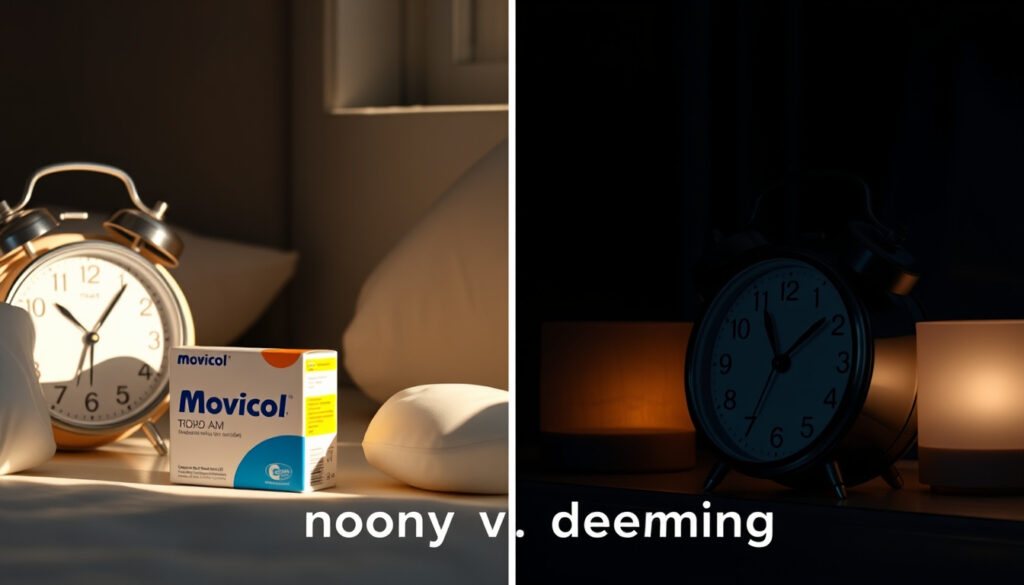
Best Time of Day to Take Movicol: Night vs Morning & More
Anyone who has stared at a packet of Movicol at 11 pm knows the real question isn’t whether it works, but when on earth to take it. The patient leaflet is simple: Movicol can be taken at any time of day, with or without food, so morning and night are both legitimate (Electronic Medicines Compendium patient leaflet). What actually decides the best time is your routine, your water intake, and how your body responds over 24 to 48 hours.
Typical onset of relief: 24-48 hours (NHS guidance) · Standard dose per sachet: 125 ml water (EMC leaflet) · Daily sachet range: 1 to 3 sachets (NHS guidance) · Maximum daily dose: 4 sachets (adults) (EMC leaflet) · Time of day flexibility: Any time, with or without food (EMC leaflet)
Quick snapshot
- Movicol can be taken at any time of day (EMC (Movicol Plain leaflet))
- Each sachet dissolves in 125 ml of water (EMC (Movicol Plain leaflet))
- Relief usually arrives within 24 to 48 hours (NHS macrogol guidance)
- Whether morning or evening dosing works better for an individual (NHS macrogol guidance) (NHS common questions about macrogol)
- Long-term daily use beyond two weeks without medical review (NHS common questions about macrogol)
- Exact extra fluid needs on top of the 125 ml per sachet (EMC (Movicol Plain leaflet)) (NHS common questions about macrogol)
- Routine constipation: 1 to 3 sachets daily (NHS macrogol guidance)
- Short-term maximum: 4 sachets daily (EMC (Movicol Plain leaflet))
- Faecal impaction: 8 sachets within 6 hours, up to 3 days (EMC (Movicol Plain leaflet))
- Pick a consistent time and repeat it daily (EMC (Movicol Plain leaflet)) (NHS side-effects guide)
- If bloating or nausea develop, try taking it with meals (NHS side-effects guide)
- If symptoms persist beyond two weeks, seek medical advice (NHS common questions about macrogol) (NHS side-effects guide)
Movicol at a glance
Seven numbers do most of the work here, and they follow one pattern: the medicine is flexible about time and strict about water.
| Fact | Value | Source |
|---|---|---|
| Active ingredient | Macrogol 3350 | EMC (Movicol Plain leaflet) |
| Dosage form | Powder for oral solution | EMC (Movicol Plain leaflet) |
| Typical adult dose | 1 to 3 sachets daily | NHS macrogol guidance |
| Maximum adult dose (short-term) | 4 sachets daily | EMC (Movicol Plain leaflet) |
| Water per sachet | 125 ml | EMC (Movicol Plain leaflet) |
| Onset of action | 24 to 48 hours | NHS macrogol guidance |
| Common side effects | Bloating, flatulence, nausea | NHS side-effects guide |
The implication: for most people the practical question isn’t which hour works, it’s whether the sachet was dissolved properly and whether enough fluids followed.
Is it better to take Movicol at night or morning?
This is the question behind most searches, and the clinical guidance doesn’t favour either side. The longer answer involves routine, other medicines, and what you want the morning to look like.
Can I take Movicol at any time of day?
The clock is the wrong variable here. Movicol pulls water into the bowel to soften stool, so the outcome depends on hydration and consistency, not on whether the sachet lands at 7 am or 11 pm.
The Movicol Plain patient leaflet states the medicine can be taken at any time of day, with or without food (EMC (Movicol Plain leaflet)). The NHS publishes its macrogol guidance around dose count rather than a schedule: one to three sachets a day according to severity, with fluid intake treated as part of the treatment (NHS macrogol guidance). There is a nuance. Official guidance doesn’t rank night against morning, and there is no evidence that a later dose outperforms an earlier one (NHS macrogol guidance). What the guidance does stress is spacing: other oral medicines need at least one hour before or after macrogol, so a fixed routine makes that gap easier to protect (NHS macrogol overview).
What this means: unless another medicine is involved, the evidence doesn’t pick a side between night and morning. The only schedule that matters is the one you can repeat without thinking.
When to take Movicol before or after food?
Food is the second most common worry, and it’s also the easiest to settle. The official sources agree: meals don’t change how the medicine works.
Does food affect how Movicol works?
- Movicol can be taken with or without food (EMC (Movicol Plain leaflet))
- Food and drink can be consumed normally while taking macrogol (NHS common questions about macrogol)
- No interaction between macrogol and food is reported in the product information (EMC (Movicol Plain leaflet))
Mechanically, this makes sense. Macrogol is an osmotic laxative: it holds water in the bowel, which softens stool and raises frequency without chemically stimulating the bowel nerves (EMC (Movicol Plain leaflet)). The medicine’s job is physical, so there is no chemical window to schedule around.
The NHS does mention meals in one situation: if the medicine upsets your stomach, trying it with meals, or between meals depending on the symptom, can help (NHS side-effects guide).
Should I take Movicol on an empty stomach?
- An empty stomach is not required (EMC (Movicol Plain leaflet))
- If nausea or discomfort appears, the NHS’s first practical suggestion is to take it with food (NHS side-effects guide)
- The 125 ml of dissolving water matters more than the state of your stomach (EMC (Movicol Plain leaflet))
The empty-stomach idea doesn’t come from the product information. With Movicol, food is neutral, and occasionally a useful buffer.
Why this matters: if you’ve been forcing yourself to take Movicol before breakfast and feeling queasy, you have permission to move it to a mealtime. The efficacy won’t change.
How long does it take for 4 sachets of Movicol to work?
There’s a difference between the everyday question, “when will I feel it?”, and the clinical answer, which is tied to dose and hydration. Both are simpler than most people expect.
How long does it take for Movicol to work in adults?
- Typical onset: 24 to 48 hours (NHS macrogol guidance)
- Routine dosing: one to three sachets daily, adjusted to severity (NHS macrogol guidance)
- Higher doses can produce a faster response, but the medicine still needs enough water to work (EMC (Movicol Plain leaflet))
The mechanism explains the delay. Movicol doesn’t force a bowel movement the way a stimulant would; it rehydrates hardened stool, and that takes time to build up in the colon (EMC (Movicol Plain leaflet)). The NHS frames 24 to 48 hours as the normal window, so a dose taken tonight typically produces a result the next day or the day after (NHS macrogol guidance).
Does Movicol work if already constipated?
- Yes: treating established constipation is the medicine’s intended use (EMC (Movicol Plain leaflet))
- For severe blockages, a separate faecal-impaction protocol applies: eight sachets within six hours, for up to three days (EMC (Movicol Plain leaflet))
- Extra fluids are especially important on that higher-dose regimen (NHS macrogol guidance)
The impaction regimen is not a stronger daily routine; it’s a separate protocol that should follow the leaflet or a professional’s instructions. The same leaflet advises people with heart conditions not to exceed two sachets in one hour (EMC (Movicol Plain leaflet)).
The four-sachet question deserves a direct answer. Four is the short-term maximum for routine constipation in adults, not a starting dose and not a daily habit (EMC (Movicol Plain leaflet)). If four sachets still isn’t enough, the sensible next step is a clinician’s review rather than an endless dose escalation, because daily use beyond a short course should be supervised (NHS common questions about macrogol).
The pattern: the clock starts at 24 hours, not 24 minutes. Movicol is rehydration work, and the four-sachet scenario is a signal to look for help, not a licence to push further.
What are the side effects of taking Movicol daily?
Daily use raises two separate questions: is it safe, and what will it feel like? The official sources answer both.
Can I take Movicol every day?
Daily use is reasonable in the short term, but it isn’t open-ended. Two weeks is the usual short-term horizon; anything longer should be a conversation with a clinician, not a repeat purchase.
Taking Movicol daily is generally safe for short periods, but it comes with side effects. The NHS lists diarrhoea, abdominal pain, indigestion, wind, nausea, and vomiting among the common ones (NHS side-effects guide). Bloating and flatulence are the most frequent complaints, which fits a medicine that pulls water into the bowel.
If diarrhoea develops, the NHS says reducing the dose can be considered (NHS side-effects guide). That adjustment comes before stopping completely, and definitely before adding anything else.
What is the recommended maximum duration of use?
- Short-term daily use of up to two weeks is generally considered safe (NHS common questions about macrogol)
- Long-term daily use should be supervised by a healthcare professional (NHS common questions about macrogol)
- The higher impaction regimen should follow professional instructions, with extra fluids treated as part of the protocol (NHS macrogol guidance)
The two-week figure is a checkpoint, not a cliff edge. Daily use beyond that isn’t automatically dangerous, but constipation that keeps coming back deserves investigation rather than a bigger self-managed dose.
The trade-off: Movicol’s side effects are mostly digestive and mostly manageable. The bigger risk is silent — daily use stretching into months while the cause of the constipation goes unexamined.
What happens if you don’t drink enough water on Movicol?
This is the question that separates a good outcome from a frustrating one. The medicine’s entire mechanism depends on water being available in the bowel.
Why is water important when taking Movicol?
- Each sachet must be dissolved in 125 ml of water (EMC (Movicol Plain leaflet))
- That 125 ml does not count toward your normal daily fluid intake (EMC (Movicol Plain leaflet))
- The NHS advises drinking plenty of fluid while taking macrogol to maintain hydration (NHS macrogol overview)
Macrogol is osmotic: it draws water into the colon to soften stool. If the body is short on water, there is less to draw on, stool stays hard, and the medicine under-delivers (EMC (Movicol Plain leaflet)). The usual warnings apply when fluids slip — headache, dry mouth, darker urine — and constipation simply doesn’t lift.
How to stay hydrated while using Movicol?
- Treat the 125 ml dissolving water as part of the dose, not part of your day’s fluids (EMC (Movicol Plain leaflet))
- Keep your normal fluid routine going alongside the sachets (NHS macrogol overview)
- On higher-dose regimens, extra fluids are particularly important (NHS macrogol guidance)
- For children using Movicol Paediatric Plain, the dilution is smaller at 62.5 ml per sachet (EMC (Movicol Paediatric Plain leaflet))
- Movicol Ready to Take skips water entirely, but the same hydration logic applies (EMC (Movicol Ready to Take leaflet))
The practical translation is straightforward: if you usually drink little water, Movicol will make that visible fast. Stool that stays hard after a few days is often a hydration problem wearing a medication problem’s clothes.
The catch: the same mechanism that softens stool can dehydrate you if you under-pour. The 125 ml in the glass is the dose; the rest of the day is the support system.
Pros and cons of daily Movicol use
Daily Movicol use is common, and the balance between benefits and drawbacks depends on how carefully the medicine is handled.
Upsides
- Can be taken at any time, with or without food (EMC (Movicol Plain leaflet))
- Works by binding water in the bowel rather than stimulating bowel nerves (EMC (Movicol Plain leaflet))
- Short-term daily use is generally well tolerated (NHS side-effects guide)
- Flexible dosing allows adjustment from one to three sachets a day (NHS macrogol guidance)
Downsides
- Requires deliberate hydration beyond the 125 ml per sachet (EMC (Movicol Plain leaflet))
- Common side effects include bloating, wind, nausea, and diarrhoea (NHS side-effects guide)
- Other oral medicines must be spaced by at least one hour (NHS macrogol overview)
- Daily use beyond a short course needs medical supervision (NHS common questions about macrogol)
The trade-off: Movicol is flexible enough to fit almost any schedule, but that flexibility shifts responsibility onto the patient — you supply the water, protect the medication gap, and know when to stop self-managing.
A simple process for finding your best time
There’s no clinical reason to take Movicol at a specific hour, so the process below treats timing as a habit problem, not a pharmacology puzzle.
- Review your other medicines first. Space other oral medicines at least one hour before or after macrogol (NHS macrogol overview). If your morning routine already includes several pills, evening may be the cleaner slot.
- Pick a moment you can repeat. Any time of day is clinically acceptable (EMC (Movicol Plain leaflet)); choose a cue — morning coffee, toothbrush, evening television — that you won’t forget.
- Prepare the sachet properly. Dissolve one sachet in 125 ml of water and drink it; never swallow the powder dry (EMC (Movicol Plain leaflet); NHS macrogol guidance).
- Protect hydration for the rest of the day. The 125 ml doesn’t count toward normal fluid intake (EMC (Movicol Plain leaflet)), so keep your usual water routine going.
- Let 24 to 48 hours be your judge. Onset takes at least a day; if nausea or bloating appear, try taking it with meals, and if diarrhoea develops, reduce the dose (NHS side-effects guide).
The thread through all five steps is the same: the time of day matters less than the water around it and the routine that protects it.
Why this matters: a reliable routine beats a perfect time every week, and the official guidance doesn’t recognise a perfect time anyway.
What’s confirmed, what’s still unclear
Sorted by source, the confirmed list is long and practical, while the unclear areas are narrower than most people assume.
Confirmed facts
- Movicol can be taken at any time of day (EMC (Movicol Plain leaflet))
- Each sachet must be dissolved in 125 ml of water (EMC (Movicol Plain leaflet))
- Relief usually occurs within 24 to 48 hours (NHS macrogol guidance)
- Taking it with food does not change its efficacy (EMC (Movicol Plain leaflet))
- Short-term daily use of up to two weeks is generally safe (NHS common questions about macrogol)
What’s unclear
- Whether morning or evening dosing produces better outcomes for a given person (NHS macrogol guidance)
- Long-term safety of daily use beyond two weeks without supervision (NHS common questions about macrogol)
- The exact amount of additional fluid needed beyond the sachet’s 125 ml (EMC (Movicol Plain leaflet))
- The assumption that Movicol must be taken on an empty stomach — the leaflet explicitly says with or without food (EMC (Movicol Plain leaflet))
- The assumption that 125 ml of dissolving water covers your fluid needs — it does not replace normal intake (EMC (Movicol Plain leaflet))
The pattern: the confirmed facts cover everything a patient needs to act on — timing, water, duration. The unclear areas are mostly about individual variation, where a doctor’s input replaces guesswork.
What official sources actually say
Four statements from the primary sources settle most of the timing argument.
For constipation, adults usually take one sachet one to three times a day, with the dose depending on how severe the constipation is.
— NHS macrogol dosing guidance
Movicol can be taken at any time of day, with or without food.
— EMC (Movicol Plain patient leaflet)
The water used to dissolve the sachet does not replace the person’s normal daily fluid intake.
— EMC (Movicol Plain patient leaflet)
Movicol Ready to Take is consumed directly from the sachet, needs no dilution, and can be taken at any time with or without food or drink.
— EMC (Movicol Ready to Take leaflet)
The implication: reading the primary sources together, the answer to “best time” is almost anticlimactic — there is no best time, only a best routine.
The takeaway
The evidence lands on a quiet but useful conclusion: Movicol doesn’t need to be scheduled around the clock or the kitchen table — it needs to be scheduled around your memory and your water bottle. Patients who get consistent results take the sachet at a repeatable time, keep drinking fluids through the day, and treat two weeks without improvement as a signal to call a doctor rather than to raise the dose. For the average adult managing constipation at home, the decision is clear: pick the time you’ll actually remember, hydrate around it, and bring any need for longer-term daily use to a clinician instead of self-managing it.
Related reading
- Is Bowel Leakage a Sign of Cancer? Causes & Warning Signs
- Easy Ways to Eat Healthier: 10 Simple Tips & Swaps
Frequently asked questions
Can I take Movicol at night if I prefer morning bowel movements?
Yes. The product information allows Movicol to be taken at any time of day, with or without food (EMC (Movicol Plain leaflet)). Taking it in the evening is a reasonable way to aim for a morning result, keeping in mind that onset typically takes 24 to 48 hours (NHS macrogol guidance).
Can I take Movicol with other medications?
Other oral medicines should be taken at least one hour before or after macrogol (NHS macrogol overview). If you’re on a complex medicine schedule, ask a pharmacist to help you map the gaps.
How long can I safely use Movicol daily?
Short-term daily use of up to two weeks is generally considered safe (NHS common questions about macrogol). Longer daily use should be supervised by a healthcare professional, since persistent constipation may need investigation.
Should I stop taking Movicol if I experience diarrhoea?
The NHS advice is to consider reducing the dose if diarrhoea develops (NHS side-effects guide). If diarrhoea is severe or continues, stop and talk to a doctor.
Can I mix Movicol into other drinks?
Movicol Plain is designed to be dissolved in 125 ml of water, and the powder should never be swallowed dry (EMC (Movicol Plain leaflet)). The Movicol Ready to Take version skips water entirely (EMC (Movicol Ready to Take leaflet)). If you want to mix it with juice, check with a pharmacist first.
Does Movicol cause dependence?
Macrogol isn’t a stimulant laxative; it works by binding water in the bowel rather than stimulating bowel nerves (EMC (Movicol Plain leaflet)). The practical risk is less about physical dependence and more about relying on daily use beyond two weeks without medical review (NHS common questions about macrogol).
More related posts
 Irish Driving Test Road Signs: The Complete RSA Guide
 Mater Private Visiting Hours: Dublin and Cork Rules
 SHEIN Discount Code Ireland: Save 50% or More
 Simple Hair Styles for Men: Top Low-Maintenance Cuts
 Paddy Power Football Today – Odds, Tips & Free Coupon
 DCU St. Patrick’s Campus: Map, Location & Facilities Guide
 Listowel Do You Know? Facts, History & Culture
 This Is Spinal Tap – The Essential Guide to the Mockumentary
