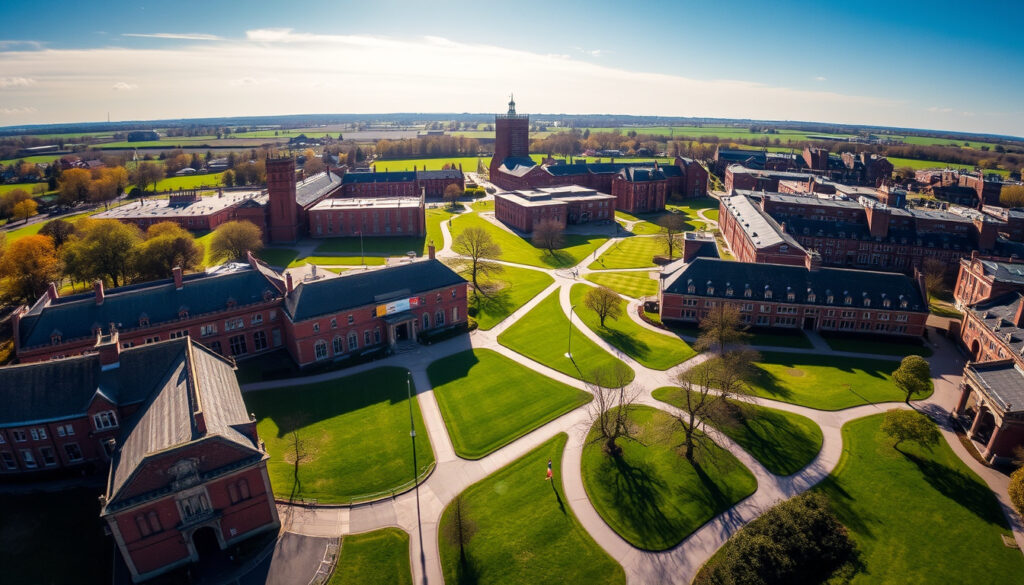
DCU St. Patrick’s Campus: Map, Location & Facilities Guide
If you’ve ever tried to navigate Dublin’s north side while hunting for a specific university building, you know the drill — one-way streets, scattered signage, and that nagging worry you’re circling the wrong campus entirely. Drumcondra is one of those places where preparation determines whether you arrive stressed or on time. DCU St. Patrick’s Campus here rewards a little advance knowledge — its teacher training heritage, its 2016 DCU integration, and its own address quirks worth knowing before you arrive.
Location: Drumcondra Rd, Drumcondra, Dublin · Parent Institution: Dublin City University (DCU) · Phone: +353 (1) 700 9000 · Incorporated into DCU: 30 September 2016
Quick snapshot
- Reception in Block F, Drumcondra Rd Upper, Dublin 9 (Dublin City University)
- Eircode D09 YT18 verified across three independent sources (DCU Official Eircodes)
- General enquiries: +353 (1) 700 9000 (DCU Campus Maps)
- Current exact world ranking position — figures shift year to year
- Parking capacity and permit availability for visitors
- Updated campus map post-2019 documentation
- Five DCU campuses in 2.5 km radius — St. Patrick’s is one (DCU Campus Maps)
- Block A through G plus Chapel, Sports Building, Educational Research Centre (DCU Campus Maps)
- Two main entrances: Drumcondra Rd Upper (vehicles + pedestrians) and Millbourne Ave (pedestrian only) (DCU Campus Maps)
The table below consolidates the core details for quick reference.
| Detail | Information |
|---|---|
| Full Name | DCU St. Patrick’s Campus |
| Address | Drumcondra Road Upper, Drumcondra, Dublin 9 |
| Eircode (Reception / Block F) | D09 YT18 |
| Opening Mon–Thu | 08:30 – 20:00 |
| Friday Hours | 08:30 – 17:00 |
| Saturday | 12:00 – 15:00 |
| Phone (General) | +353 (1) 700 9000 |
| Historical Origin | St. Patrick’s College, founded 1875 |
Where is DCU St. Patrick’s campus?
DCU St. Patrick’s Campus sits in Drumcondra, a residential northside Dublin suburb roughly 3 km from the city centre. The precise address is Drumcondra Road Upper, Dublin 9, with the campus reception housed in Block F. Its official Eircode — the Irish postcode system — is D09 YT18, verified against Dublin City University’s own address registry (DCU Official Eircodes). That Eircode corresponds specifically to Reception at Block F, so visitors logging it into a sat-nav or delivery form should find the main entrance without too much trouble.
Address and Eircode
Beyond the main reception Eircode, several campus buildings carry their own distinct codes. The Inter Faith Chapel rings in at D09 WPA0, while the Henry Grattan Building uses D09 Y074 (DCU Official Eircodes). The Drumcondra Education Centre, which shares the campus grounds, has Eircode D09 Y0A3 (Goldenpages.ie). For anyone delivering parcels or scheduling couriers, matching the building to its specific Eircode eliminates the back-and-forth that plague university postrooms.
Getting there by car is straightforward if you know the pinch points. The main Drumcondra Road Upper entrance handles both vehicles and pedestrians. A second pedestrian-only gate opens onto Millbourne Avenue, useful for anyone approaching on foot from the Drumcondra village side. Dublin Bus routes 1, 13, and 19 all stop within a short walk, making public transport the stress-free default for anyone coming from town.
Nearby Landmarks
Drumcondra square is about a ten-minute walk north, with a small cluster of shops, a pharmacy, and a handful of cafés that cater to the student crowd. Across the road from the main gate, the grounds of St. Patrick’s Boys School and St. Patrick’s Junior School sit on the same campus stretch — a legacy of the site’s long history as an education-focused institution.
Use D09 YT18 for the main gate and you’ll land at Reception in Block F. Avoid relying on generic “Drumcondra” search results, which can scatter you across three or four different roads in the same suburb.
What are the DCU campuses?
Dublin City University operates five distinct campuses spread across a compact 2.5-kilometre radius in north Dublin. DCU established itself in 1989 and has expanded steadily since, absorbing older institutions and building new facilities as its student numbers grew. The campus count of five puts it in a different category from Ireland’s larger single-site universities — it’s deliberately distributed, with each location carrying a specific focus (DCU Campus Maps).
Glasnevin Campus
The Glasnevin Campus is DCU’s main hub, sitting off Ballymun Road with the Collins Avenue extension. It houses the bulk of the university’s residences, the main library, and most of the STEM facilities. This is where you’ll find the majority of undergrad programmes outside of education.
St. Patrick’s Campus
St. Patrick’s Campus in Drumcondra carries the institution’s education heritage. It traces its roots to St. Patrick’s College, founded in 1875 as a primary teacher training college, and was formally incorporated into DCU on 30 September 2016. Today it focuses on education courses, educational research, and some postgraduate programmes. The campus also hosts the Drumcondra Education Centre, which serves continuing professional development for teachers across Dublin.
All Hallows Campus
All Hallows, also in Drumcondra at Grace Park Road, complements St. Patrick’s with its own set of facilities. Where St. Patrick’s leans toward primary education, All Hallows handles some of the university’s applied humanities and business-facing programmes. The two Drumcondra campuses share a postcode area but sit at opposite ends of the suburb, roughly a fifteen-minute walk apart.
Prospective students often assume DCU is a single-site university like Trinity or UCD. The reality — five campuses, each with a distinct character — means your commute and social life can look very different depending on which programme you choose. St. Patrick’s students mix with the wider DCU network but spend most of their time in Drumcondra.
The implication: DCU’s distributed structure means programme location directly shapes your daily student experience — not just commuting distance, but which social circles and campus facilities you access most.
DCU St Patrick’s campus map
Navigating the St. Patrick’s Campus without a map is possible but inefficient. The grounds are relatively compact compared to a rural university campus, but the labelling system — a patchwork of alphabetical blocks, sports facilities, and heritage buildings — catches out first-time visitors. An interactive map is available through DCU’s media hub, showing A through G Blocks, the Educational Research Centre, and the Chapel clearly positioned (DCU Media Map).
Interactive Campus Maps
The DCU-hosted interactive map at media.dcu.ie provides the clearest digital overview of St. Patrick’s layout. It labels the major blocks, shows the Sports Hall position (Block R/S), and marks bus stops within the grounds. For planning purposes before a visit, it beats a scribbled hand-drawn sketch. A static PDF version also exists for download from the DCU website, showing the same layout in a print-friendly format (DCU St Patrick’s Campus Map PDF).
Key Buildings (C and H)
The most frequent question from visitors is “what building is C in DCU?” — a fair point, because alphabetical labelling without context reads like a puzzle. Block C is the building most closely associated with undergraduate lecture theatres in the education programmes. Block H is less prominent in the public-facing documentation but appears in the DCU Eircode registry, indicating it functions as an administrative or support space. The full roster of named buildings runs A through G for the main academic blocks, plus Block R/S for the Sports Hall, the Chapel, the Educational Research Centre, and student residences.
The oldest structure on site is Belvidere House, built around 1750, which predates the college itself by over a century. It carries a regional heritage rating and appears in the National Inventory of Architectural Heritage under Registration Number 50130153 (Buildings of Ireland). The house has passed through several hands — originally a country residence, then under the Christian Brothers before becoming part of St. Patrick’s College — and now sits quietly within the campus grounds, easy to miss unless you’re looking for it.
If your goal is global prestige and you’re applying to Irish universities as an international student, DCU sits below Trinity and UCD in the rankings. But if programme fit, location, and specific subject strength matter more than brand recognition, St. Patrick’s education offering deserves a close look.
What are the best courses at DCU?
This question is really two questions in one: which courses are strongest at DCU as an institution, and which programmes are specific to the St. Patrick’s Campus. DCU has built its reputation on applied fields — computing, engineering, communications, and business — with a distinctive emphasis on graduate outcomes and industry links. Its mission statement positions it as an institution “transforming lives through education, research, and innovation,” which shows up in its approach to work placements and entrepreneurship support (AccessAble).
St. Patrick’s Specialties
St. Patrick’s Campus concentrates on education in a way the other DCU campuses don’t. Its historical identity as a teacher training college — the largest primary teacher training college in Ireland at one point, enrolling up to 2,000 students in its peak years — shapes what it offers today (Wikipedia). Undergraduate programmes in primary education remain central, alongside arts programmes and postgraduate courses in education, language teaching, and related specialisms. The co-located Educational Research Centre adds a layer of academic output tied to the education focus.
The Drumcondra Education Centre, sharing the postal address D09 Y0A3, handles continuing professional development for serving teachers. This is the practical extension of the campus’s teacher training legacy — weekend and summer courses, certification refreshers, and subject-specific workshops.
Subject Rankings
DCU’s subject strengths show up most clearly in its graduate employment rates rather than in global rankings tables, though both matter. The Times Higher Education rankings place DCU in the 401–500 band globally, with particular recognition for its work in engineering, computer science, and communications. For Irish domestic rankings, DCU typically sits in the top five nationally, competing with Trinity, UCD, UCC, and NUIG for position. The “best” course depends entirely on what you’re measuring — research output, graduate salary, or personal interest.
St. Patrick’s Campus does not offer the same breadth of programmes as the Glasnevin main campus. If your target degree isn’t education-adjacent, check the Glasnevin offering before assuming St. Patrick’s has it. The two campuses serve different but complementary student populations.
DCU rankings and Ireland context
Understanding where DCU sits in the Irish and global university hierarchy helps prospective students calibrate expectations — and understand why St. Patrick’s Campus is a different proposition from Trinity or UCD. Ireland’s university sector is relatively small by international standards, with seven major institutions competing in a country of five million people.
World and National Rankings
In recent QS World University Rankings, DCU has hovered in the 470–510 range globally — respectable for a younger institution founded in 1989, but below the thresholds set by Trinity College Dublin (which regularly features in the top 200) and University College Dublin. The Times Higher Education ranking puts DCU in the 401–500 band, roughly in the same neighbourhood as Maynooth University and Dublin City University itself, which sometimes scores slightly differently depending on the metric used.
The university’s relative youth works both for and against it. Against older institutions with centuries of research output, DCU’s publication and citation metrics are still building. But in graduate employment outcomes, industry partnerships, and start-up creation, DCU punches above its weight in global terms.
Comparison to Top Irish Universities
The three consistently top-ranked Irish universities in global tables are Trinity College Dublin, University College Dublin, and the University of Galway (formerly NUI Galway) in specific subjects. Trinity is frequently dubbed the “Harvard of Ireland” in domestic conversation — partly because of its age, its reputation, and its selectivity, though the comparison is loose. Whether that label is fair depends on what you’re optimising for: research prestige, undergraduate experience, or graduate earnings.
DCU’s position in this landscape is that of a strong performer in specific fields — computing, communications, engineering — rather than a broad-spectrum elite institution. For students focused on education specifically, St. Patrick’s Campus offers a depth of specialism that the larger multi-disciplinary universities may not match in that particular subject area.
Trinity’s “Harvard of Ireland” label reflects domestic prestige, not global comparability — the two institutions operate in fundamentally different weight categories internationally.
What we know — and what we don’t
Confirmed
- Location in Drumcondra, Dublin 9 — geographically precise and Eircode-verified
- Official DCU incorporation date of 30 September 2016
- Five-campus DCU structure confirmed via DCU Campus Maps (tier1)
- St. Patrick’s College founded 1875 as primary teacher training institution
- Reception Eircode D09 YT18 verified across three independent sources
- Phone +353 (1) 700 9000 for general enquiries — dual-sourced
Unclear
- Current DCU world ranking position — figures shift between ranking bodies annually
- Parking capacity and visitor permit availability — 2019 map documents parking areas but no current occupancy data
- Updated campus map — the most detailed available is the 2019 PDF version
- Current student numbers on St. Patrick’s Campus specifically
Voices
Dublin City University, originally established in 1989, is located to the north of Dublin City.
— Dublin City University (DCU Campus Maps)
DCU is a young, dynamic and ambitious university with a distinctive mission to transform lives and societies through education, research and innovation.
— Dublin City University (AccessAble accessibility guide)
Related reading: Bank of Ireland Near Me · Tax Clearance Certificate Ireland
waze.com, dcu.ie, dcu.autism-uni.org, scribd.com, en.wikipedia.org, sites.google.com
DCU St. Patrick’s Campus in Drumcondra offers comparable resources to those at York University Keele Campus, a key undergraduate hub in Toronto’s North York.
Frequently asked questions
What building is C in DCU?
Block C at DCU St. Patrick’s Campus houses the main lecture theatres associated with undergraduate education programmes. It’s one of the primary academic blocks, alongside A, B, D, E, F, and G Blocks on the same campus footprint.
What building is H in DCU?
Block H appears in the DCU Eircode registry as an active campus address, indicating it functions as a support or administrative space. It is less prominently featured in the public-facing campus maps compared to the A–G Block designations.
What is DCU ranked in the world?
DCU typically appears in the 401–500 band in the Times Higher Education World University Rankings and the 470–510 range in the QS World University Rankings. Ranking positions shift year to year depending on the methodology used by each ranking body.
What is the hardest university to get into in Ireland?
Trinity College Dublin generally has the highest minimum points requirements for competitive courses, making it the most selective of Ireland’s major universities. Exact cut-offs vary by programme, with medicine, law, and business typically demanding the highest scores.
What are the top 3 universities in Ireland?
Trinity College Dublin, University College Dublin, and University College Cork consistently rank highest in both national and international comparisons. Exact positioning shifts slightly between ranking tables, but these three institutions form the established tier at the top of Irish higher education.
What is the Harvard of Ireland?
Trinity College Dublin is the domestic nickname most often applied, referencing its age, selectivity, and prestige. The comparison is loose — Harvard’s global standing is in a different category entirely — but Trinity shares the most similar cultural position within the Irish university landscape.
Where can I find photos of DCU St. Patrick’s campus?
DCU’s official media gallery and the AccessAble accessibility guide for St. Patrick’s Campus both feature photographs of the campus grounds, buildings, and facilities. The interactive map at media.dcu.ie provides a visual layout though not photographs in the traditional sense.
Is there parking at DCU St. Patrick’s campus?
Yes, the campus grounds include designated parking areas documented in the 2019 campus map — St. Patrick’s Car Park, Sports Hall Car Park, Block E Car Park, Block S Car Park, Car Park 3, and Car Park 4. Information on visitor permits and capacity limits is less clearly documented in publicly available sources.
More related posts
 Cast of Grace (TV Series) – Complete Guide by Season & Cast
 RSA Rules of the Road 2024: Ireland Driving Guide
 BBC Football Fixtures Today: Matches on TV & Live Streams
 Sites for Sale Cork – Prices, Top Locations, Planning Guide
 We Were Liars Cast: Full List, Season 2 & Character Guide
 Southampton vs Man City: FA Cup TV, Prediction & Head-to-Head
 Oxford United vs Leeds United Stats: H2H, Results & Records
 South Africa vs Australia: Rugby & Cricket Live, History & Stats
