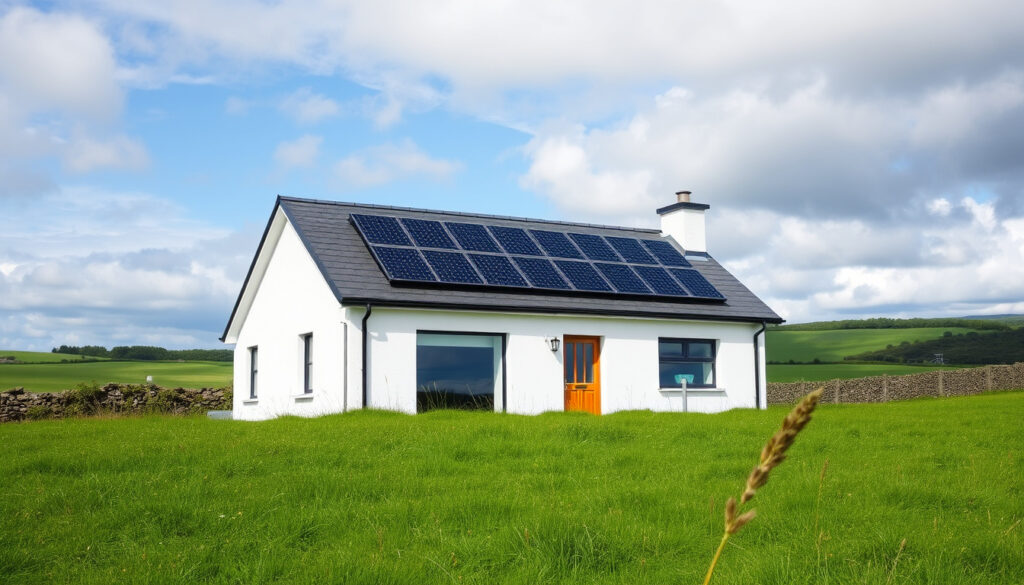
Solar Panels for Home in Ireland: Cost, Grants & Drawbacks
If you’re a homeowner in Ireland looking at solar panels, the first thing you notice is the price tag — and the second thing is the grant that cuts it down. Between SEAI funding and rising electricity costs, more people are asking whether solar PV makes financial sense right now. Here’s what the numbers actually say for Irish households in 2025.
Average cost for a typical Irish home (3-bed semi): €6,000 – €9,000 after SEAI grant ·
SEAI grant maximum: €1,800 ·
Typical annual savings on electricity bill: €50 – €300 ·
Average payback period: 5 – 7 years
Quick snapshot
- €6,000 – €9,000 average (Citizens Information)
- SEAI grant up to €1,800 (SEAI)
- Payback 5-7 years (Citizens Information)
- High upfront cost (Citizens Information)
- Reduced output on cloudy days (Citizens Information)
- Inverter replacement cost (Citizens Information)
- SEAI grant for all homeowners (Citizens Information)
- Warmer Homes Scheme for low-income (SEAI)
- No fully free panels currently (Citizens Information)
A 4-kWp system after grant costs roughly €5,200—about 12 months’ Irish rent in parts of Dublin, but it cuts grid dependency by up to 70%. The trade-off: those savings show up over five to seven years, not next month.
The key facts table below summarizes the central numbers every homeowner needs before comparing quotes.
| Label | Value |
|---|---|
| Average system cost (after grant) | €6,200 (3.5kW system) |
| SEAI grant maximum | €1,800 |
| Typical number of panels | 8-12 for a 3-bed semi-detached |
| Annual savings range | €50 – €300 |
How many solar panels are needed to fully power a house?
Typical system sizes for Irish homes
- Average Irish household uses about 4,200 kWh/year, according to data from Citizens Information.
- A 3-4 kW system typically requires 8-10 panels (SEAI).
- A 10kW system can fully power a large house but depends on usage and roof space (SolarInfo.ie).
Understanding your household energy consumption
Your annual consumption determines how many panels you need. A 3-bed semi with 4,200 kWh/year of usage typically needs 8-12 panels. Larger homes with higher usage or electric heating may need 12-16 panels (Citizens Information).
The implication: Most Irish homes don’t need to fully power themselves from solar — they size their system to offset a large chunk of daytime usage and export excess to the grid.
How to calculate your panel count
Divide your annual kWh usage by 1,100 (typical kWh output per kWp in Ireland) and multiply by panel wattage. For a 3-bed semi, this usually works out to 8-10 panels at 400W each (SEAI guidance).
How much do 10 solar panels cost in Ireland?
Price breakdown: panels, inverter, installation
- Typical 10-panel system (3.5-4 kW) costs €7,000 – €9,000 before grant (SolarInfo.ie).
- SEAI grant of €1,800 reduces outlay to €5,200 – €7,200 (Citizens Information).
- Prices vary by installer: Energia, Purevolt, Electric Ireland, Solar Home (SolarInfo.ie).
One installer source describes a 4 kWp system for a typical 3-bed semi as costing about €4,200 to €6,200 after the grant and 0% VAT (SaveOnHeat.ie).
The pattern: The biggest cost variable isn’t the panels — it’s the installer markup and roof complexity. Quotes for the same system size vary by €1,500 to €2,000 across providers.
SEAI grant impact on cost
The grant rate is €700 per kWp for the first 2 kWp and €200 per kWp for the next 2 kWp up to a maximum of 4 kWp (SEAI). A 4 kWp system receives the maximum €1,800 grant under the 2025 schedule (Citizens Information). This means a 10-panel system at 4 kWp qualifies for the full grant amount.
Comparison of quotes from major providers
Three confirmed installer ranges show that net costs cluster around €5,000-€7,000 for a 3.5-4 kWp system after the grant.
| Provider | Typical system size | Before grant | After grant |
|---|---|---|---|
| SolarInfo.ie | 4.4 kWp | €8,300-€9,000 | €6,500-€7,200 |
| SaveOnHeat.ie | 4 kWp | €6,000-€8,000 | €4,200-€6,200 |
| Purevolt (via cost guide) | 3.5 kWp | €8,000 | €6,200 |
The catch: These are installer self-reported ranges. Actual quotes depend on roof type, orientation, and whether battery storage is included.
The SEAI grant covers about one-fifth of the typical system cost. A homeowner in Cork with a south-facing roof at €6,200 net cost gets a better deal than one in Donegal with a complex install quoted at €8,000 — same grant, different outcome.
What is the biggest drawback of solar panels?
Upfront cost and payback time
High initial investment (€6,000+) is the most cited drawback (Citizens Information). Payback periods of 5-7 years mean homeowners who move within that window may not recoup the investment. Inverters typically last 10-15 years and cost €1,000+ to replace (SEAI).
Dependence on sunlight in Ireland’s climate
Performance on cloudy days is reduced but still functional — panels produce 10-25% of rated capacity on overcast days (Citizens Information). Ireland’s daylight hours still give viable annual generation, especially in spring and summer. Modern panels (e.g., monocrystalline) perform better in diffuse light (SEAI).
The trade-off: Ireland gets about 1,000-1,200 kWh/kWp annual yield — roughly 60% of southern Spain’s. Yet lower baseline temperatures improve panel efficiency. The yield gap is narrower than most expect.
Maintenance and inverter lifespan
Inverters typically last 10-15 years and cost €1,000+ to replace (SEAI). Panel degradation is about 0.5-0.8% per year, meaning a 25-year-old system still runs at 80-85% capacity (Citizens Information).
Upsides
- Reduces grid electricity usage by up to 70%
- SEAI grant cuts upfront cost by €1,800
- Low maintenance — mainly panel cleaning and inverter checks
- Increases property value in Energy Performance ratings
Downsides
- High upfront cost (€6,000+) is the main barrier
- Payback period of 5-7 years if you stay put
- Reduced output on cloudy days (10-25% of peak)
- Inverter replacement costs €1,000+ after 10-15 years
What this means: The biggest drawback isn’t technology — it’s cashflow. A homeowner who plans to stay for a decade will likely break even and then save. But a short-term owner or renter may not see the benefit.
Who qualifies for free solar panels in Ireland?
SEAI grant eligibility criteria
SEAI grants are available to all homeowners for solar PV installations — no income threshold (Citizens Information). The grant is capped at €1,800 for up to 4 kWp (SEAI).
Free schemes for pensioners and low-income households
Pensioners may qualify for additional support through the Warmer Homes Scheme (SEAI). However, free panels are not typically offered; grants reduce cost significantly. The Warmer Homes Scheme provides up to 100% funding for energy upgrades (including solar) for eligible low-income households (Citizens Information).
The pattern: “Free solar panels” marketing often refers to these grant-funded schemes with conditions. No Irish program hands out panels with zero paperwork and zero household contribution.
How to apply for the SEAI solar grant
- Get at least 3 quotes from SEAI-registered installers (SEAI).
- Choose an installer and let them apply for the grant on your behalf (Citizens Information).
- Post-installation inspection by SEAI before grant payment (SEAI).
Do solar panels work on cloudy days?
How solar panels generate energy without direct sunlight
Solar panels still produce 10-25% of rated capacity on cloudy days (Citizens Information). Ireland’s daylight hours still give viable annual generation — the key factor is annual insolation, not daily peak (SEAI).
Performance of monocrystalline vs polycrystalline panels in low light
Modern panels (e.g., monocrystalline) perform better in diffuse light (SEAI). Monocrystalline panels have efficiency ratings of 20-23% versus 15-17% for polycrystalline, giving them an edge in Ireland’s cloudy conditions (Citizens Information).
Expected output on overcast days in Ireland
A 4 kWp system on an overcast day in January might generate 2-4 kWh — enough to run a fridge, lights, and TV for a day, but not a heat pump or electric shower (SEAI). By contrast, a sunny June day on the same system can produce 20-28 kWh (Citizens Information).
The implication: Ireland’s solar generation is seasonal — spring and summer provide the bulk of annual yield. Households with high daytime usage (e.g., working from home) benefit most because they use the generation directly.
Confirmed facts
- SEAI grant of up to €1,800 is available for solar PV installations (Citizens Information).
- A 3.5kW system typically costs €6,000-€9,000 before grant (SolarInfo.ie).
- Solar panels generate energy on cloudy days at reduced capacity (Citizens Information).
What’s unclear
- Exact payback period varies based on energy usage and future electricity prices.
- Future SEAI grant levels may change.
A residential solar PV system in Ireland is often presented by installers as costing roughly €5,000 to €10,000 out of pocket after grant and 0% VAT.
SolarInfo.ie
SEAI’s residential solar electricity grant page was last updated in November 2025, confirming the current grant schedule remains in effect.
SEAI
For Irish homeowners looking at solar panels in 2025, the decision comes down to tenure and timing. The SEAI grant covers a meaningful chunk of the upfront cost, but the real savings arrive after five to seven years of reduced bills. A homeowner who plans to stay a decade or more gets the best outcome from the math — especially with rising electricity prices.
solartechonline.com, mysolar.ie, seai.ie, solarinfo.ie, solarinfo.ie, solargeneration.ie, ges.ie, solarhome.ie
For a comprehensive overview of costs and savings, check out this guide on solar panels for home in Ireland for 2026.
Frequently asked questions
How much does a solar panel system cost in Ireland after the SEAI grant?
A typical 4 kWp system costs about €6,200 after the SEAI grant of €1,800, based on quotes from multiple installers (Citizens Information).
What size solar system do I need for my home?
Most 3-bed semi-detached homes in Ireland need an 8-12 panel system (3-4 kWp) to offset about 70% of grid usage (SEAI).
How long does it take to recoup the cost of solar panels?
Payback period is typically 5-7 years in Ireland, depending on your energy usage, electricity prices, and whether you have battery storage (Citizens Information).
Are there any solar panel incentives for pensioners?
Pensioners may qualify for the Warmer Homes Scheme, which provides up to 100% funding for eligible energy upgrades including solar panels (SEAI).
Can I install solar panels myself in Ireland?
No — SEAI grants require installation by a registered professional, and DIY installation voids warranty and insurance (SEAI).
How long do solar panels last?
Panels typically last 25-30 years with 0.5-0.8% annual degradation. Inverters need replacement every 10-15 years (Citizens Information).
Do I need planning permission for solar panels in Ireland?
Generally no, unless your home is in a protected structure or Architectural Conservation Area. Standard roof-mounted panels are exempt development (Citizens Information).
What happens to solar panels when they stop working?
Panels can be recycled through PV Cycle Ireland. Most manufacturers offer 25-year performance warranties (SEAI).
Related reading
- How Do Tariffs Work? — Understanding electricity tariffs in Ireland
- Old Age Pension Entitlements in Ireland 2025: Complete Guide — For pensioners exploring Warmer Homes Scheme eligibility
More related posts
 Irish Car Registration Plates List: County Codes & How to Check
 How to Stop a Nosebleed: First Aid, Causes & When to Seek Help
 Listowel Do You Know? Facts, History & Culture
 Cheapest Dyson Hair Dryer UK: Best Prices & Discounts
 Cast of Scrubs (TV Series): Full Actors List by Season
 Noel Edmonds Net Worth: TV Fame to Bankruptcy and Back
 Bohemians vs Cork City: Prediction, H2H & Live Stream 2025
 How to Say Good Morning in Italian: All Expressions & Pronunciations
