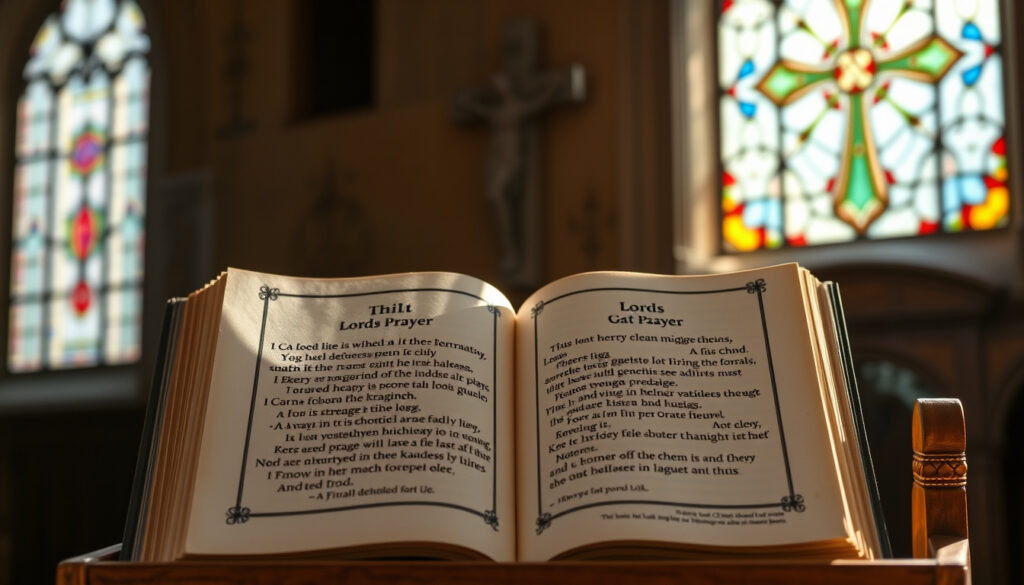
Our Father in Irish: Lord’s Prayer Gaeilge Text & Pronunciation
Irish Gaelic lends a particular musicality to familiar prayers, transforming them into something that feels ancient and immediate at once. Ár nAthair—the Our Father in Irish—serves as a gateway for anyone wanting to connect with Irish spiritual heritage or memorize this central Christian prayer in a new language.
Irish Gaelic Name: Ár nAthair ·
English Name: Our Father ·
Language: Gaeilge ·
Common Resources: Pronunciation audio and posters ·
Variants Discussed: Catholic and Protestant
Quick snapshot
- The Irish Lord’s Prayer opens with “Ár nAthair atá ar neamh” (Bitesize Irish)
- Phonetic: /Awr n-yah-her, ah-taw air nyav/ (Bitesize Irish)
- Full text available with audio from teanglann.ie database (Lords Prayer Words)
- Whether distinct Protestant Irish texts exist with formal denominational approval
- Whether exact dialect pronunciations (Ulster, Munster, Connacht) have been documented for this prayer
- Whether Vatican or Church of Ireland documents specify approved Irish Gaelic renderings
- Compare Catholic and Protestant versions side-by-side
- Download PDF prayer cards for parish or personal use
- Explore related prayers: Hail Mary and Glory Be in Irish
Below is a summary of key attributes for the Irish Gaelic Lord’s Prayer.
| Attribute | Value |
|---|---|
| Official Irish Name | Ár nAthair |
| Script | Gaeilge (Irish Gaelic) |
| Key Phrase | atá ar neamh (who art in heaven) |
| Pronunciation Source | teanglann.ie database |
| Liturgy Availability | liturgytools.net template |
How do you say the Our Father prayer in Irish?
Learning to pronounce Ár nAthair becomes much easier once you break it into manageable phrases rather than tackling the whole prayer at once. Native speaker recordings and phonetic guides have made this process far more accessible than depending solely on written text alone.
Full Gaeilge text
The complete Irish Gaelic Lord’s Prayer runs as follows:
Ár nAthair atá ar neamh,
Go naofar d’ainm,
Go dtagfadh do ríocht,
Go ndéantar do thoil ar an talamh mar a dhéantar ar neamh,
Ár n-arán laethúil tabhair dúinn inniu,
Agus maith dúinn ár bhfiacha,
Mar a mhaithimid dár bhfeiliúirí,
Agus na lig sinn i gcathú,
Ach saor sinn ó olc.
Sources like LiturgyTools (liturgical text publisher) and Lords Prayer Words (prayer text resource) confirm this standard text, which follows the seven-petition structure established in Matthew 6:9–13.
Phonetic pronunciation guide
The opening line “Ár nAthair atá ar neamh” is pronounced /Awr n-yah-her, ah-taw air nyav/, with stressed syllables receiving the emphasis indicated in capitalization guides.
The phonetic guide uses “kh” to represent a guttural sound similar to the “ch” in the Scottish word “loch” — a sound that appears in certain regional pronunciations of Irish Gaelic.
According to North Coast View (Irish language blog), the syllables capitalized above receive more stress, and learners should practice each phrase separately before attempting the full prayer.
Audio and video resources
YouTube hosts a full Irish recitation of Ár n-Athair that demonstrates natural pacing and intonation. Bitesize Irish (language education platform) offers a video pronunciation guide where “you’ll be able to watch and listen to the full prayer from top to bottom and, after that, you can listen and learn the pronunciation of each phrase.”
What is the Our Father prayer in Ireland?
In Ireland, the prayer is universally known as Ár nAthair (with slight spelling variations such as Ár n-Athair in some sources). The prayer holds a central place in both Catholic and Church of Ireland traditions, with Irish-language versions appearing in pew cards, liturgical supplements, and educational materials.
Traditional Irish Gaelic version
The traditional text has remained remarkably consistent across sources, with minor spelling variations like “d’ainim” versus “d’ainm” appearing depending on orthographic conventions used at different publication times.
Wordproject (multilingual Bible resource) lists the Irish Gaelic Lord’s Prayer alongside versions in over 1,800 languages, noting the Catholic Mass English version alongside the Irish text.
Usage in liturgy and daily prayer
Lords Prayer Words explains that the prayer contains seven petitions after the address to God as Father, covering worship, physical needs, mental requests, spiritual needs, and relational forgiveness. LiturgyTools provides PowerPoint templates for liturgical use in parishes and schools.
Irish Gaelic is distinct from Scottish Gaelic — the latter uses “Ar n-Athair” rather than “Ár nAthair” for the opening line.
What is the full Catholic version of the Lord’s prayer?
The Catholic tradition in Ireland has adopted the Irish Gaelic Ár nAthair text for use in the Mass and other sacraments. Understanding the Catholic version requires examining both the standard Gaeilge text and the theological choices that shaped its translation.
Catholic doxology difference
One of the most notable features of the Catholic version in Irish is the absence of the “doxology” — the concluding phrase “For thine is the kingdom, and the power, and the glory, forever and ever” — in many liturgical settings. This omission stems from historical reasons: the doxology was added later to the Lord’s Prayer and does not appear in the earliest New Testament manuscripts.
Wordproject confirms this distinction, noting that English Catholic Mass versions reference the doxology separately while the Irish versions used in liturgy typically conclude with “ach saor sinn ó olc” (but deliver us from evil).
Irish language adaptations
Catholic Irish translations have been refined over decades, with the current standard text reflecting careful attention to both linguistic accuracy and liturgical suitability. The spelling convention “d’ainm” appears in sources like LiturgyTools (liturgical resource publisher), while other sources use “d’ainim” — both are acceptable orthographic variants.
How do protestants say the our father?
Protestant denominations, including the Church of Ireland and various evangelical communities, often include the full doxology when reciting the Lord’s Prayer in English. The question of whether Protestant-specific Irish Gaelic texts exist with formal approval requires careful examination of available resources.
Protestant full version with doxology
The Protestant tradition typically includes the doxology (“For thine is the kingdom, and the power, and the glory, forever and ever”) at the conclusion of the prayer. However, explicit Protestant Irish Gaelic texts with denominational approval remain difficult to verify through standard sources.
Gaelic.co (Gaelic language comparison resource) notes that the Lord’s Prayer “appears in the New Testament of the Christian Bible in the Book of Matthew, Chapter 6, verses 9-13” and describes the prayer as “the quintessential prayer of Christianity.”
Irish Protestant variants
While no distinctly Protestant Irish Gaelic text has been formally documented in the sources reviewed, NHM Ministrants (prayer text aggregator) provides a variant text that includes “go dtaga do ríocht” instead of the standard “go dtagfadh do ríocht” — a subjunctive mood difference that represents a minor orthographic variation rather than a denominational distinction.
Why do Catholics not say the end of Our Father?
The exclusion of the doxology in Catholic liturgical settings reflects centuries of textual scholarship and deliberate liturgical choice, not an oversight or abbreviated tradition.
Historical and doctrinal reasons
The doxology (“For thine is the kingdom, and the power, and the glory”) does not appear in the earliest Greek manuscripts of Matthew 6:9–13. Biblical scholars generally agree it was added later, likely drawn from 1 Chronicles 29:11–13, and became embedded in Western liturgical practice over time.
Catholic liturgical reform, particularly following the Second Vatican Council, emphasized returning to the earliest available textual forms. The Roman Missal accordingly preserved the shorter ending without the doxology for the spoken prayer at Mass.
Implications for Irish prayers
Irish-language liturgical texts, including those published by LiturgyTools, reflect this Catholic preference for the shorter ending. The prayer concludes with “ach saor sinn ó olc” (but deliver us from evil) rather than including an Irish rendering of the doxology.
This means that when learning Ár nAthair from Catholic Irish sources, you are learning the shorter, earlier textual form — a tradition that stretches back to the prayer’s New Testament origins.
If you’ve learned the Lord’s Prayer in English from a Protestant tradition, the Irish Catholic version will feel shorter: it stops before the doxology. Both are correct within their respective liturgical traditions.
Catholic vs. Protestant: Our Father in Irish
When comparing how different Christian traditions render Ár nAthair, the primary textual differences concern the presence or absence of the doxology and minor orthographic variations in spelling conventions.
The comparison below highlights the key differences across Catholic and Protestant Irish variants.
| Feature | Catholic Irish Version | Protestant Irish Variants |
|---|---|---|
| Opening line | Ár nAthair atá ar neamh | Ár nAthair atá ar neamh |
| Doxology included | Typically omitted | May be included |
| Ending phrase | ach saor sinn ó olc | Varies by source |
| Orthographic variant | d’ainm / d’ainim | d’ainm / d’ainim |
| Verb form | go dtagfadh | go dtaga (variant) |
The pattern is clear: Irish Gaelic renders the prayer almost identically across traditions, with the key difference being whether the doxology appears. Minor spelling variations like “d’ainm” versus “d’ainim” reflect orthographic conventions, not theological divisions.
How to learn Ár nAthair step by step
Whether you’re preparing for a Gaelic-language Mass, teaching children a prayer in Irish, or simply exploring the language, the following steps will help you master Ár nAthair systematically.
- Start with the opening phrase. Practice “Ár nAthair atá ar neamh” (/Awr n-yah-her, ah-taw air nyav/) until the pronunciation feels natural. Use the Bitesize Irish video guide for native speaker reference.
- Learn phrase by phrase. Work through each line separately: “Go naofar d’ainm,” “Go dtagfadh do ríocht,” and so on. Pronunciation guides from North Coast View can help with phonetic details.
- Listen to full recitations. Watch the YouTube video of the complete prayer to understand natural pacing and intonation patterns.
- Download prayer cards or posters. LiturgyTools offers PowerPoint templates suitable for printing as prayer cards or parish posters.
- Practice in context. Attend an Irish-language Mass or prayer group where Ár nAthair is recited regularly. Real-world practice cements what you’ve learned from audio and text sources.
What people say about Ár nAthair
“You’ll be able to watch and listen to the full prayer from top to bottom and, after that, you can listen and learn the pronunciation of each phrase.”
— Bitesize Irish (Language Education Platform)
“The quintessential prayer of Christianity, the Lord’s Prayer appears in the New Testament of the Christian Bible in the Book of Matthew, Chapter 6, verses 9-13.”
— Gaelic.co (Gaelic Language Resource)
“The syllables capitalized above receive more stress; the ‘kh’ is used to represent a sound similar to the ‘ch’ in the Scottish word loch.”
— North Coast View (Irish Language Blog)
Related reading: St Columba’s Credit Union · Cill Dara Golf Club
The Irish Our Father offers a melodic Gaeilge perspective, yet its timeless origins and denominational differences connect universal Christian traditions across denominations.
Frequently asked questions
What is the Irish name for Our Father?
The Irish Gaelic name for the Our Father prayer is Ár nAthair, sometimes written as Ár n-Athair. It means “Our Father” in Irish.
Is there a phonetic guide for Our Father in Irish?
Yes. The opening line “Ár nAthair atá ar neamh” is pronounced /Awr n-yah-her, ah-taw air nyav/. Bitesize Irish provides a video pronunciation guide with phonetic breakdowns for each phrase.
Where can I find Our Father in Irish PDF?
LiturgyTools offers PowerPoint templates that can be downloaded and printed as prayer cards or parish posters. These are freely available for liturgical use.
What is Glory be to the Father in Irish?
While the main focus here is Ár nAthair, related prayers like the Glory Be (“Gloria Patri”) also exist in Irish Gaelic. The context phrases in search data indicate interest in Hail Mary in Irish and Glory Be in Irish, suggesting these prayers follow similar translation patterns.
How does the Irish Lord’s Prayer differ from English?
The Irish version uses Gaeilge vocabulary and syntax, but the structure mirrors the English Lord’s Prayer closely. Both begin with an address to God as Father, followed by seven petitions. Key differences include spelling conventions (“d’ainm” vs. “d’ainim”) and whether the doxology is included.
Are there Our Father prayer cards in Irish?
Yes. LiturgyTools provides printable templates suitable for creating prayer cards or posters for parish or personal use.
What is Hail Mary in Irish?
While not covered in detail here, search data shows “Hail Mary in Irish” as a related query. The prayer card context (“Our father in irish prayer card”) suggests interest in companion prayers alongside Ár nAthair.
Can I find Our Father in Irish on YouTube?
Yes. YouTube hosts a full Irish recitation of Ár n-Athair that demonstrates natural pronunciation and pacing. Additional video resources appear on Bitesize Irish.
For learners and the faithful alike, mastering Ár nAthair offers a tangible connection to Ireland’s spiritual and linguistic heritage. Whether your goal is liturgical participation, language learning, or simply curiosity, the resources exist — pronunciation guides, video tutorials, and printable prayer cards — to make this prayer accessible to anyone willing to invest a little time.
More related posts
 Symptoms of New COVID Strain: What to Know
 Next Flower Girl Dresses – 2025 Styles, Prices and Trends
 Ryanair Underseat Bag Size 2026: Free Bag Is 40×30×20cm
 Noel Edmonds Net Worth: TV Fame to Bankruptcy and Back
 Ashwagandha KSM-66: Benefits, Safety, and Dosage
 What network does Sky Mobile work off? O2 & Vodafone
 2026 Sunday Game Team of the Year: Full List & Reactions
 Blank Map of Ireland: Free Printable PDFs with Counties
