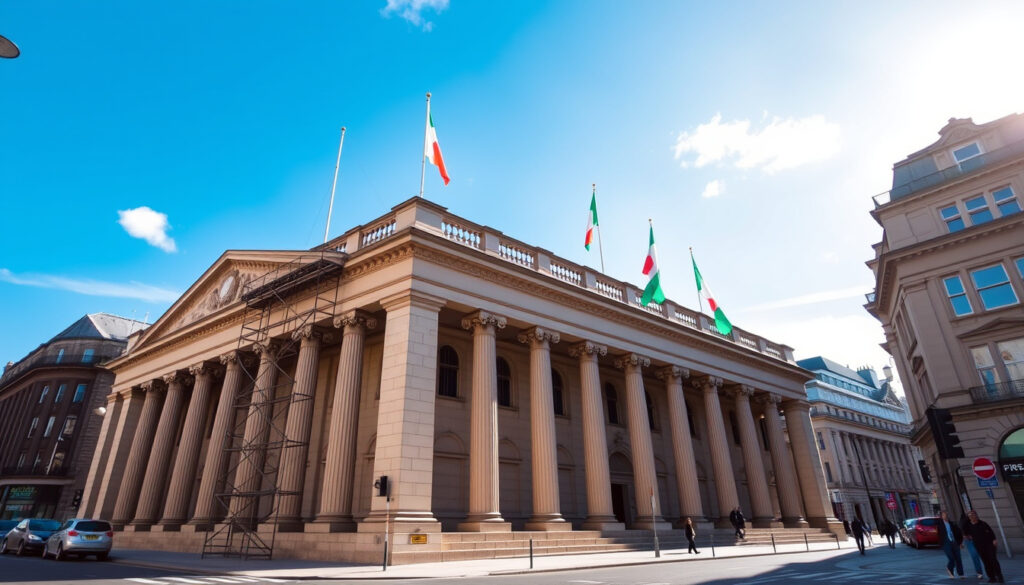
General Post Office Dublin: History, Visit, and Upgrade Guide
Few buildings in Dublin carry as many stories as the General Post Office on O’Connell Street. It opened in 1818 as a hub for mail, but within a century it became the symbol of a nation’s fight for independence.
Built: 1818 ·
Role in 1916: Easter Rising headquarters ·
Museum: GPO Museum (permanent attraction) ·
Address: O’Connell Street Lower, Dublin 1
Quick snapshot
- Opened in 1818 (GPO Museum)
- Headquarters of Irish Volunteers during 1916 Easter Rising (Ask About Ireland)
- Gutted by fire in 1916 and reopened in 1929 (RTÉ Century Ireland)
- GPO Museum covers 1916 Rising to the Troubles (Visit Dublin)
- Exact phasing and timeline of the government upgrade plan
- Whether the building will close to the public during any part of the works
- Long‑term impact on postal operations
- 24 April 1916 – rebels seize the GPO (Wikipedia)
- 29 April 1916 – rebels surrender, building in ruins (ConnollyCove)
- 1929 – restored GPO reopens (RTÉ Century Ireland)
- 2016 – GPO Museum opens (GPO Museum)
- Major government upgrade with restoration of the facade and modernised infrastructure
- Museum expected to expand
Seven facts across the building’s history, its 1916 role, and its modern visitor experience, one pattern: the GPO is both a working post office and a living monument.
| Label | Value |
|---|---|
| Year built | 1818 |
| Architect | Francis Johnston |
| 1916 role | Rebel headquarters |
| Museum opening | 2016 |
| Upgrade allocation | €200m–€500m (2023) |
| Address | O’Connell Street Lower, Dublin 1 |
| Phone | 01 705 8833 |
What is the history of the General Post Office in Dublin?
The GPO opened in 1818 (GPO Museum). On Easter Monday 1916, rebels seized the building (Wikipedia) and used it as headquarters (Ask About Ireland). The building was gutted by fire and reopened in 1929 (RTÉ Century Ireland). The GPO Museum opened in 2016 (Visit Dublin).
The implication: the GPO is not just a post office; its walls have witnessed the birth of a republic, and the museum ensures that story remains accessible.
Why was the GPO so important in the 1916 Easter Rising?
- The GPO was chosen as the Rising’s command centre because of its prominent location on what was then Sackville Street (now O’Connell Street) and its symbolic role as the heart of British communication in Ireland (RTÉ Century Ireland).
- Pearse read the Proclamation of the Republic from the steps of the GPO, declaring a provisional government (Wikipedia).
- Two republican flags were hoisted over the building – a green flag with the harp and a tricolour (Wikipedia).
The pattern: the GPO became the focal point for the rebellion, and its occupation sent a clear message that Ireland’s independence was being declared from the very institution that represented British rule.
Where is the General Post Office in Dublin?
- The GPO sits at 1 O’Connell Street Lower, Dublin 1, D01 F5P2 (GPO Museum official site).
- It is a standout landmark on the city’s main thoroughfare, opposite the Spire and near the O’Connell Monument.
- The building remains the registered office and main post office of An Post, Ireland’s national postal service.
The catch: while the GPO is a working post office and tourist draw, visitors can walk right in during business hours – the ground floor is open for mail and parcel services, and the museum is accessible from the same entrance.
For readers planning a trip, also check out our guide to Free Museums in Dublin for other budget-friendly cultural stops.
What is happening to the GPO in Dublin?
- In 2023 the Irish government announced a major capital upgrade for the GPO, with a budget of between €200 million and €500 million (RTÉ News).
- The plan includes full restoration of the historic facade, modernisation of internal infrastructure, and an expansion of the museum space.
- The post office remains open during the works, though some areas may be temporarily restricted.
What this means: the GPO is being transformed from a heritage building into a 21st‑century civic and cultural hub, while preserving its role as Ireland’s most iconic postal address.
Is the GPO in Dublin worth visiting?
- The GPO Museum has reportedly won awards including the Micheletti Prize at the European Museum Academy Awards (ConnollyCove).
- Exhibits cover the 1916 Rising, the War of Independence, the Civil War, and the Troubles, using interactive displays and original artefacts (Visit Dublin).
- Bullet holes from the 1916 fighting are still visible on the building’s exterior columns – believed to be original damage preserved as a memorial.
- Entry fee is €12 for adults, with concessions available.
- Tripadvisor reviewers rate it highly for its historical impact and the friendly, knowledgeable guides.
The trade-off: the museum is compact – most visitors spend 60–90 minutes – but it delivers a concentrated, emotional journey through Ireland’s path to independence.
For a broader picture of Irish geography, see our County Map of Ireland.
What is a General Post Office?
- A general post office is the main postal facility in a city or country, historically central to communications and mail distribution.
- In Dublin, the GPO has been the headquarters of the postal service since 1818 and is now the home of An Post (RTÉ Century Ireland).
- Across many countries, GPO buildings often reflect the architectural style and civic pride of their era; Dublin’s neoclassical design by Francis Johnston is a prime example.
- The Dublin GPO is unique because its 1916 role has elevated it from a postal centre to a national symbol of independence.
The takeaway: while the term “general post office” is functional, Dublin’s GPO carries a weight of history that few other post offices can match.
Pros and cons of visiting the GPO
Upsides
- Deep historical significance – see the actual site where Ireland’s independence was proclaimed
- Award‑winning museum with interactive exhibits suitable for all ages
- Free entry to the public ground‑floor post office
- Central location, easy walking distance from many Dublin attractions
Downsides
- Museum entry costs €12 (concessions available)
- Renovation works may cause temporary closures or noise
- The museum is relatively small – expect 60–90 minutes
- Photography is restricted in some exhibition areas
The implication: despite the drawbacks, the GPO remains a must‑see for anyone interested in Ireland’s journey to independence.
How to plan your visit (step by step)
- Check opening hours: the post office is open Monday–Saturday 9 am–5:30 pm; the museum opens daily 10 am–5 pm (last entry 4 pm).
- Buy tickets online to avoid queues, especially during peak tourist season.
- Allow 90 minutes for the museum and another 15 minutes to see the bullet holes and the Proclamation plaque outside.
- Combine with other O’Connell Street landmarks: the Spire, the Garden of Remembrance, and the Dublin Writer’s Museum are all within a 10‑minute walk.
- Use public transport: the GPO is served by Dublin Bus (routes 1, 7, 11, 13, 16, 39, 41) and the Luas Red Line (Abbey Street stop).
What this means: a well‑planned visit can pack a lot of history into a short time.
Timeline of the GPO
The key milestones in the GPO’s history are shown below.
| Date/Period | Event |
|---|---|
| 1814–1818 | GPO building constructed to designs by Francis Johnston |
| 24–29 April 1916 | Easter Rising – rebels occupy the GPO, Pearse reads Proclamation (RTÉ Century Ireland) |
| 1916–1920s | Building heavily damaged by shelling and fire; reconstruction under way |
| 1929 | Restored GPO reopens (RTÉ Century Ireland) |
| 1980s | An Post becomes a state‑owned company; the GPO remains its headquarters |
| 2016 | GPO Museum opens to the public |
| 2023 | Government announces €200m–€500m upgrade plan |
The GPO has survived fire, war, and urban change to remain Ireland’s most recognized rebel landmark. Its €500 million makeover will decide whether it becomes a world‑class heritage site or just a renovated post office.
The pattern: each phase of the GPO’s life reflects Ireland’s evolving identity.
Clarity: what we know vs what’s still uncertain
Confirmed facts
- GPO opened in 1818 (GPO Museum)
- Rebel headquarters during the 1916 Easter Rising (Ask About Ireland)
- Building gutted by fire and reopened in 1929 (RTÉ Century Ireland)
- GPO Museum opened in 2016
- Government allocated €200m–€500m for upgrade in 2023
What’s unclear
- Exact phasing and duration of the renovation work
- Whether any part of the building will close during the upgrade
- Long‑term impact on postal operations
“The GPO Museum brings the story of 1916 to life in a way that resonates with every generation.”
– GPO Museum Curator
“This upgrade will secure the GPO’s place as a working post office and a heritage attraction for the next 100 years.”
– An Post spokesperson, RTÉ News
“Visiting the GPO was the highlight of my trip – you can still see the bullet holes in the columns.”
– Tripadvisor reviewer, August 2024
The implication: while many details are settled, key questions remain about the upgrade’s execution.
For anyone planning a visit to Dublin, the GPO offers a rare chance to stand in the same room where a republic was declared. The choice is clear: skip it and miss the emotional core of modern Irish history, or spend 90 minutes and walk out with a deeper understanding of a nation’s birth.
Frequently asked questions
How much does it cost to enter the GPO Museum?
Adult tickets are €12, with concessions for students, seniors, and children.
Are there guided tours of the GPO?
Yes, the museum offers guided tours included with entry. Audio guides are also available.
Can I send mail from the GPO today?
Absolutely – the ground floor is a fully functioning post office run by An Post.
What are the GPO opening hours?
Post office: Mon–Sat 9 am–5:30 pm. Museum: daily 10 am–5 pm. Last entry 4 pm.
Is the GPO accessible for wheelchair users?
The ground floor and museum are fully wheelchair accessible; there is a lift to the museum level.
Are the bullet holes on the GPO real?
Yes – the holes in the columns are original damage from the 1916 fighting, preserved as a memorial.
How long does a visit to the GPO Museum take?
Most visitors spend 60–90 minutes in the museum, plus time to see the exterior and the Proclamation plaque.
More related posts
 Cast of Drop (Film) 2025: Full List of Actors & Characters
 Wyndham Grand Costa del Sol: Location, Amenities, Guide
 Lilo & Stitch (2025 Film) – Guide to Release, Cast and Streaming
 Pat McDonagh Net Worth: Age, Career, and Irish Wealth
 City of Shadows Netflix: Plot, Cast, Reviews & Release Date
 Breaking News Irish Mirror: Guide to Ireland’s Fastest Source
 Where Was Broadchurch Filmed? Filming Locations Guide
 Fairytale of New York: Full Story of MacColl and MacGowan
