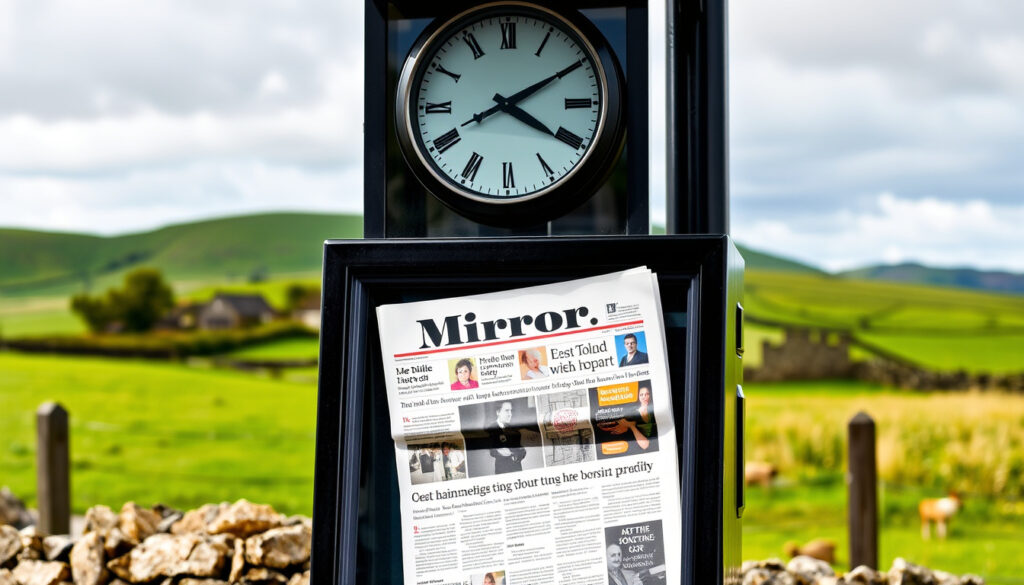
Breaking News Irish Mirror: Guide to Ireland’s Fastest Source
When a big story breaks in Ireland, the Irish Mirror is often among the first outlets to land it on your phone — but speed is not the same as reliability. This guide covers the Irish Daily Mirror’s track record, its competitors, and what to expect when relying on it for live updates.
Daily readership (est.): Over 500,000 unique visitors ·
Coverage focus: Irish news, crime, politics, showbiz, sport ·
Parent company: Reach plc ·
Founding year: 1935 (as Sunday Mirror)
Quick snapshot
- Founded 1935, tabloid format, owned by Reach plc (Irish Mirror About Us)
- Covers crime, politics, sport, showbiz (Irish Mirror About Us) (Irish Mirror About Us)
- National public broadcaster, founded 1926, funded by licence fee (Reuters Digital News Report 2024 via University of Sheffield)
- Most trusted news source in Ireland at 72% trust (Reuters Digital News Report 2024 via University of Sheffield)
- Part of Landmark Media (The Irish Examiner), founded 2002 (About BreakingNews.ie)
- Dedicated breaking news alerts, independent editorial line (About BreakingNews.ie)
Six key facts, one pattern: the Irish Mirror is a commercial tabloid anchored by a long-established print legacy but now competing in a crowded digital space dominated by public-service and niche players.
| Attribute | Value |
|---|---|
| Full name | Irish Daily Mirror |
| Owner | Reach plc |
| Headquarters | Dublin, Ireland |
| Format | Tabloid (print + digital) |
| Main competitor | Irish Sun |
| Regulator | IPSO |
Where can I find the latest breaking news from the Irish Mirror?
Using the Irish Mirror website
The primary source is the Irish Mirror’s own site at irishmirror.ie, which the publisher describes as a “trusted destination” for news, showbiz, and sports (Irish Mirror About Us). The front page refreshes throughout the day, and dedicated sections cover Dublin, crime, politics, and more. The site also hosts a clear corrections policy: the outlet says it corrects errors “as soon as possible” once inaccuracies are confirmed (Irish Mirror About Us).
For a reader chasing real-time updates, the website is the fastest path. But the site’s own disclaimer warns that content is for general information only and “does not guarantee completeness, accuracy, reliability” (Irish Mirror Disclaimer).
The fastest path: The homepage is the best first alert, but it also carries the broadest disclaimer — so treat it as a starting point, not the final word.
How can I follow the Irish Mirror?
Social media channels
- Facebook: Irish Daily Mirror – the main Facebook page for breaking news feeds.
- YouTube: TheIrishDailyMirror – video coverage of major stories.
- TikTok: @irishmirror – short-form updates, popular with younger audiences.
The Trust Project, of which the Irish Mirror is a partner, notes that the outlet protects source identity while establishing reliability—a policy that extends to its social feeds (The Trust Project).
The implication: If you want the story as it happens, push notifications from the website plus Facebook and TikTok give the widest net. But the editorial quality of social posts can vary; the official site remains the authoritative version.
What type of stories does the Irish Mirror cover?
The Mirror’s official description covers news, showbiz, and sports, but the homepage’s section tree shows the real priorities: Dublin, crime, politics, and more.
Crime and court reports
Crime is the site’s most prominent beat, especially in the Dublin section, where local incidents and court coverage dominate.
Politics from the Oireachtas
Political reporting is shorter and faster than RTÉ’s, aimed at the day’s headlines rather than deep institutional analysis.
Showbiz and celebrity news
Showbiz is a core pillar, with stories that often double as social-media traffic drivers.
GAA and football sport
Sport coverage is wide but not niche; GAA and international football get the most attention.
The pattern: The Irish Mirror is a general-interest tabloid with a Dublin-centric crime edge, not a specialist outlet.
How does the Irish Mirror compare to RTÉ for breaking news?
Speed of news updates
Both outlets aim for speed, but they operate under different models. RTÉ is the national public broadcaster, funded by a licence fee and delivering news across radio, TV, and digital. The Irish Mirror is a commercial tabloid owned by Reach plc, relying on digital ad revenue and a lean newsroom. A 2024 trust study found that RTÉ holds 72% trust among Irish news consumers, while the Irish Mirror sits near the bottom of the trust rankings (Reuters Digital News Report 2024 via University of Sheffield). Speed alone doesn’t guarantee reliability—the Mirror has historically faced accuracy questions, as seen in a 2019 case where the outlet denied publishing fabricated screengrabs (Wiwibloggs).
Editorial focus differences
- RTÉ provides in-depth political analysis, investigative features, and comprehensive Oireachtas coverage.
- Irish Mirror leans heavily on crime, showbiz, and human-interest stories with a tabloid framing.
Media Bias/Fact Check rates the Irish Daily Mirror as Left-Center with Mostly Factual reporting and High Credibility (Media Bias/Fact Check). Ground News similarly summarises the outlet as Lean Left with High factuality (Ground News). The contrast with RTÉ is not just about speed but about editorial mission: one serves as a public-service watchdog, the other as a fast-turnaround commercial voice.
Why this matters: If you need immediate alerts on a Dublin crime or a celebrity story, the Mirror will often beat RTÉ. But for verified, context-rich reporting, RTÉ’s institutional weight and higher trust score make it the safer bet.
What is the difference between the Irish Mirror and the Irish Sun?
Ownership and history
The Irish Mirror has been in print since 1935 (as the Sunday Mirror) and is now part of Reach plc, the largest newspaper publisher in the UK and Ireland. The Irish Sun launched its online edition in 2018 under News UK, a rival publishing group. Both are tabloid brands, but their corporate homes shape their editorial lines. Reach plc reports digital audience figures in its annual filings, though specific Irish Mirror breakdowns are not publicly detailed (Irish Mirror About Us).
Tone and content mix
- Irish Mirror – Left-Center bias according to Media Bias/Fact Check, with heavy crime coverage and a Dublin-centric lens.
- Irish Sun – generally viewed as right-leaning, with more UK-focused showbiz and sport, though no formal rating is captured in our sources.
User sentiment on Reddit suggests the Irish Mirror is frequently criticised for click-driven headlines and perceived sensationalism (Reddit discussion). The Irish Sun faces similar critiques from its own audience. Both compete for the same reader, but the Mirror’s newsroom is larger and more embedded in local Dublin stories.
The trade-off: The Mirror offers deeper local crime and political reporting from a Left-Center perspective; the Sun brings a lighter, more entertainment-heavy mix with a conservative tilt. For breaking news on the ground in Dublin, the Mirror is the stronger choice.
The consequence: For Dublin-specific alerts, the Mirror’s speed is useful; for decisions based on a single report, treat it as one input.
Is the Irish Mirror a reliable news source?
Reliability depends on what you are using it for. As a first-alert service, the Mirror is fast and mostly factual; as a final authority, its own trust scores and reader criticism suggest you should cross-check.
Editorial standards and corrections policy
The publisher’s About Us page commits to reporting fairly, correcting errors as soon as possible, and protecting source identity. That same page says the Mirror subscribes to the Press Council of Ireland Code of Practice. A Press Ombudsman complaint against Irishmirror.ie was not upheld, which gives the outlet at least one formal win on accuracy (Press Council of Ireland).
Affiliation with Reach plc
Reach plc gives the Mirror scale, distribution, and a large commercial newsroom, but not independent ownership. Third-party ratings place the Mirror on the Left-Center of the spectrum with High factuality, while the 2024 Reuters data still ranks it among the least trusted Irish outlets.
The catch: The publisher’s own standards are standard; the audience trust data is not. Treat the Mirror as a tripwire, not the final source.
Confirmed facts and what remains unclear
Confirmed facts
- Irish Mirror is owned by Reach plc (Reach plc brands)
- Regulated by IPSO and subscribes to the Press Council of Ireland Code of Practice (IPSO)
- Rated Left-Center by Media Bias/Fact Check (Media Bias/Fact Check)
- Corrections policy published on site (Irish Mirror About Us)
- Press Ombudsman complaint against Irishmirror.ie not upheld (Press Council of Ireland)
What’s unclear
- Exact number of journalists on the breaking news desk – not publicly disclosed
- Daily digital readership figures – estimates range but no independent audit confirms them
- Consistency of fact-checking across all sections – reliance on unnamed sources is acknowledged but not independently verified (The Trust Project)
The pattern: The available records document the Mirror’s official standards, but the trust gap shows the daily execution is harder to verify.
Expert perspectives and audience sentiment
“The Irish Mirror aims to report news fairly and accurately and to correct errors or clarifications as soon as possible.”
– Irish Mirror editorial policy, Irish Mirror About Us
“We establish the reliability of unnamed sources and story provenance is the responsibility of the editor.”
– The Trust Project partner profile of Irish Mirror
“The Irish Daily Mirror is rated Left-Center with Mostly Factual reporting and High Credibility.”
– Media Bias/Fact Check
“Overall trust in Irish news stands at 46%… the Irish Daily Mirror is among the least trusted news organisations.”
– Reuters Digital News Report 2024, cited by University of Sheffield
Editor’s note: The discrepancy between the Mirror’s own policy statements and third-party trust rankings is striking. The outlet’s public commitments to accuracy are standard, but audience data and repeated social-media criticism suggest execution often falls short of those pledges. For a reader, the practical consequence is clear: the Irish Mirror is useful for initial alerts, but critical decisions or detailed understanding should be cross-referenced with higher-trust sources.
The Irish Mirror’s disclaimer states it is “not a substitute for professional advice” and that users rely on the site at their own risk (Irish Mirror Disclaimer). This is standard legal language, but it underlines that even the publisher acknowledges limits on its own accuracy.
The caution: The company’s legal language sets a low bar for reader reliance, which is why independent ratings matter more than the publisher’s own promises.
mediabias.news, trustpilot.com, irishmirror.ie, play.google.com
Frequently asked questions
What is the Irish Mirror?
The Irish Mirror is a tabloid newspaper and website covering Irish news, crime, politics, showbiz, and sport. It is published by Reach plc.
Where is the Irish Mirror based?
Its headquarters are in Dublin, Ireland.
Does the Irish Mirror have a Dublin-specific section?
Yes, the website has a dedicated Dublin section (irishmirror.ie/dublin) focusing on local crime, events, and council news.
How is the Irish Mirror funded?
It is funded through advertising revenue (digital and print) and is part of the Reach plc publishing group.
Can I subscribe to the Irish Mirror?
Print editions are available via newsagents; digital access is free on the website. There is no paid subscription model for online content.
Does the Irish Mirror cover Northern Ireland news?
Coverage occasionally includes Northern Ireland stories, but the primary focus is the Republic of Ireland, particularly Dublin.
The takeaway: These answers are a starting point; live monitoring and cross-checking remain the core habits for breaking news.
Related reading
- BBC 5 Live Radio: How to Listen in the UK, Ireland & Abroad – alternative live news source for Irish audiences.
- What Football Is On Today? Live Matches & TV Schedule – sports coverage across Irish broadcasters.
For context: Live radio and sports schedules are the kinds of secondary sources Irish readers use to fill the gaps in tabloid coverage.
More related posts
 Samsung Galaxy A41 to Buy: Price & Support in 2025
 The Fate of Ophelia Lyrics Meaning: Taylor Swift Explained
 U20 Six Nations 2026: Schedule, Lineup, Table & How to Watch
 Where Was Broadchurch Filmed? Filming Locations Guide
 Posiciones de la Liga 2025-26: Updated Standings Table
 How to Stop Apps from Crashing: Causes and Fixes
 Best Free AI Photo Editor: 100% Free Tools for Photos (2025)
 Intreo Office Near Me: Find Local Centre & Appointment Guide
