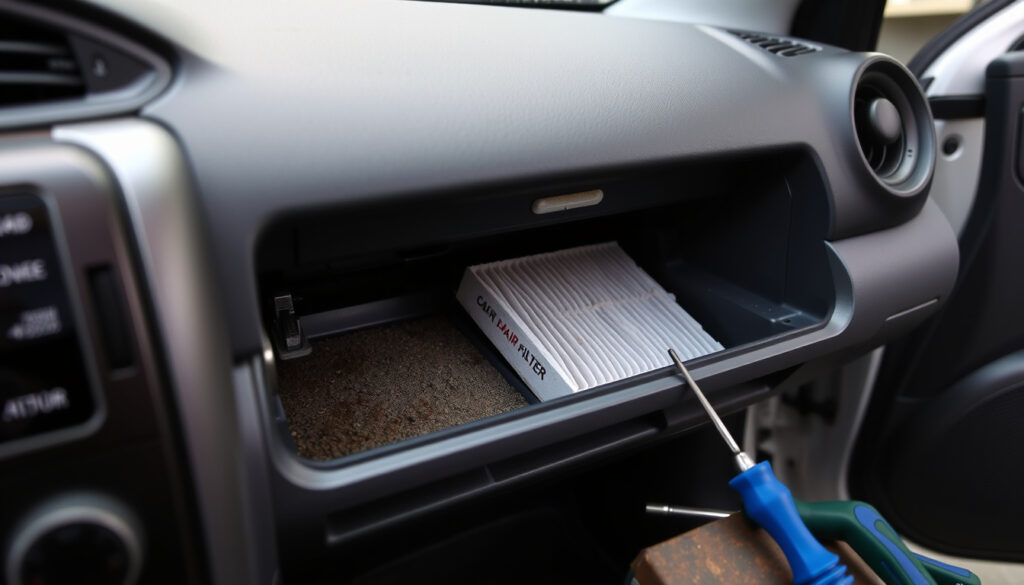
How to Change Cabin Air Filter: Toyota & Nissan DIY Guide
A musty smell whenever you fire up the AC — or vents that push noticeably weaker air than they used to — usually means your cabin air filter has passed its prime. This is a maintenance job any driver can handle in under 20 minutes with zero tools, and this guide covers the exact steps for Toyota and Nissan models so you can swap in a fresh filter and breathe easier.
DIY Time: 10-20 minutes · Common Location: Behind glove box · Replacement Frequency: Every 15,000 miles · Signs It Needs Changing: Reduced airflow, odors
Quick snapshot
- DIY replacement is possible on most vehicles (YourMechanic)
- Filter location is consistent across Toyota and Nissan models (YourMechanic)
- Exact intervals vary by vehicle and conditions
- OEM vs aftermarket filter performance differences
- Cabin filters became standard in most vehicles by the late 1990s (YouTube – Toyota)
- Replacement commonly recommended every 15,000 miles (YouTube – Toyota)
- Locate filter behind glove box in your specific model
- Purchase correct replacement filter
- Complete DIY swap in under 20 minutes
The specifications below summarize what most drivers encounter during this replacement job, though individual vehicles may vary slightly.
| Specification | Details |
|---|---|
| Access Method | Glove box removal |
| Typical Tools Required | None (optional screwdriver, flashlight) |
| Filter Type | Replaceable paper element |
| DIY Time | 10-20 minutes |
| Replacement Interval | 15,000 miles (more often in dusty areas) |
Can I replace my cabin air filter myself?
Yes — this is one of the friendlier DIY tasks under the hood. Most cabin air filters live behind the glove box, and the removal process requires no special skills or expensive equipment. A flashlight, a Phillips screwdriver for some models, and about 10 to 20 minutes are all you need. The process follows the same basic sequence whether you drive a Toyota Prius, a Nissan Altima, or dozens of other vehicles that use this behind-glove-box design.
Tools and parts required
- New cabin air filter (specific to your vehicle model)
- Flashlight (for visibility behind the glove box)
- Phillips screwdriver (only for some models like the 2022 Nissan Frontier)
- Gloves (recommended if you have dust sensitivity)
YourMechanic notes that most vehicles don’t require any tools at all — you simply release the plastic tabs holding the glove box in place. For the 2022 Nissan Frontier specifically, you’ll need a Phillips screwdriver for the screws securing the glove box, plus you’ll disconnect the glove box light and work around the fuse box. That’s an outlier, not the norm.
Step-by-step DIY process
- Empty the glove box. Remove all contents first — you don’t want items falling out when you release the box. YourMechanic identifies this as the universal first step for every vehicle.
- Release the glove box stops. For Toyota models like the Prius and Tacoma, push in on the flexible sides marked “push” to drop the glove box down. Nissan models (Altima, Rogue, Pathfinder, Sentra) typically require pressing inward on both sides to release stop tabs. Craig’s Car Care documents this method for multiple Nissan models.
- Open the filter housing. Once the glove box hangs down, locate the rectangular black plastic cover over the filter housing. Release it via the clips or screws holding it shut.
- Remove the old filter. Pull the filter straight out — don’t shake it, as this spreads debris. Note the airflow direction arrow on the old filter so you install the new one correctly. Craig’s Car Care highlights this step as critical for proper function.
- Check for a sleeve. Some models house the filter in a black plastic sleeve that pulls out entirely before you remove the filter element itself. YourMechanic documents this variation.
- Install the new filter. Slide the new filter in with the airflow arrow pointing down (this is especially important for the Nissan Frontier, per YouTube guidance).
- Reassemble in reverse order. Snap the cover shut, reposition the glove box past the stoppers, and secure any screws you removed.
The implication is clear — this is a task that rewards confidence over experience.
Craig’s Car Care puts it plainly: “Changing your cabin air filter is one of the easier DIY car care tasks—even if you’re not all that handy.”
Vehicle-specific tips
Toyota Prius and Tacoma owners will find a clip-on white box cover behind the glove box that releases without full door removal. YouTube guides demonstrate this for both models. The 2022 Nissan Frontier adds extra steps — disconnecting the glove box light and fuse box, plus using a screwdriver for screws — but the core sequence remains recognizable. Before buying a filter, YouTube mechanics recommend testing glove box removal first to confirm you understand your specific model’s latching method.
The pattern here favors beginners: most models require no tools and the procedure stays consistent across brands.
Upsides
- Saves $30-80 in labor costs vs professional service
- Takes only 10-20 minutes for most vehicles
- No special tools required for most models
- Improves air quality inside the cabin immediately
- Helps prevent strain on the HVAC system
Downsides
- Filter location varies — some vehicles are harder to access
- Wrong filter type can cause fitment issues
- Some models require partial disassembly beyond glove box
- Dust and debris can spread during removal if not careful
What are signs of a bad cabin air filter?
A clogged cabin air filter announces itself in a few predictable ways. The most common signals are reduced airflow from your vents, lingering musty or moldy odors when you run the AC, and visible dirt buildup on the filter itself during inspection. Catching these symptoms early prevents more serious problems down the line.
Reduced airflow symptoms
When the cabin air filter becomes restricted with accumulated debris, the blower motor struggles to push air through. You’ll notice weaker airflow from all vents, especially on higher fan settings. Some drivers also report that the AC takes longer to cool the cabin or that the defroster performs poorly.
Odors and health effects
A filter that’s been in service too long becomes a trap for mold, mildew, and bacteria — especially in humid climates or vehicles used frequently with the AC on recirculation mode. The result is that characteristic stale smell every time you turn on the ventilation system. For allergy sufferers, this can trigger symptoms during drives, something worth addressing given how much time people spend in their vehicles.
Three key indicators
- Weak airflow: Noticeably reduced air volume from vents
- Persistent odors: Musty or moldy smell when AC is running
- Visible dirt: Filter appears heavily soiled when inspected
The health impact extends beyond discomfort — for those with respiratory sensitivities, every drive becomes exposure to accumulated contaminants.
A neglected cabin filter doesn’t just affect comfort — it forces your HVAC system to work harder, potentially shortening the lifespan of the blower motor and evaporator coil. The cost of a $20 filter is far lower than HVAC repairs.
How often should I change my cabin air filter?
Replacement intervals depend on your vehicle and driving conditions, but the most commonly cited recommendation is every 15,000 miles. Some sources suggest annual inspection, with replacement every 12 months or at the mileage interval, whichever comes first. Dusty environments, frequent off-road driving, or heavy smoking inside the vehicle will require more frequent changes.
Manufacturer recommendations
Your owner’s manual provides the definitive interval for your specific vehicle. While many manufacturers spec 15,000 to 30,000 miles, some European brands recommend annual replacement regardless of mileage. Checking the manual before your first change establishes the baseline for your vehicle.
Driving condition factors
- Dusty or sandy environments: Check every 10,000 miles, replace more frequently
- Heavy traffic with AC on recirculation: Moisture buildup accelerates mold growth
- Smoking in vehicle: Requires more frequent replacement due to tar and smoke particles
- Regular highway vs. stop-and-go city driving: Highway driving generally pulls in less debris than urban driving
Service shop guidelines
Many service outlets like Jiffy Lube and dealer service departments follow the 15,000-mile guideline or the annual interval, whichever arrives first. Lincoln dealers advise annual checks as a conservative approach that catches issues before they become problems.
What this means: if you drive in dusty areas or notice symptoms sooner, check and replace earlier — it’s a $15-30 part versus potential HVAC repairs.
Can I just clean my cabin air filter instead of replacing it?
Cleaning can extend the life of some cabin filters, but it’s not always the right call. For standard paper-element filters — the most common type — replacement is generally the safer recommendation. Some premium charcoal or washable filters do allow cleaning, but you need to know which type you have before deciding.
Cleaning methods
If your filter is a washable foam or mesh type, you can rinse it with water, let it dry completely, and reinstall. Compressed air can blow out light debris from paper filters between replacements. However, Westside Hyundai advises that deep cleaning is rarely worth the effort for standard filters — replacement is quick and inexpensive.
When replacement is better
Paper element filters are designed for disposal, not restoration. Once they’re clogged with fine particles, vacuuming or tapping out debris won’t restore full airflow. Sam Leman’s automotive guide notes that cleaning works best for early-stage buildup but loses effectiveness as filters approach their service limit.
What to watch with pollen filters
Many newer vehicles use activated charcoal or “pollen” filters designed to absorb odors and allergens. These lose their effectiveness after cleaning and should be replaced rather than washed. Attempting to clean them can damage the delicate filtration media.
The catch: shops generally prefer full replacement over cleaning — the labor cost of cleaning often approaches the cost of a new filter. For the average driver, swapping in a fresh filter is the more practical approach.
Westside Hyundai emphasizes that shops generally prefer full replacement over cleaning — the labor cost of cleaning often approaches the cost of a new filter. For the average driver, swapping in a fresh filter is the more practical approach.
What happens if I don’t change my cabin air filter?
Neglecting your cabin air filter creates a cascade of problems that affect both your comfort and your vehicle’s health. The most immediate issues are poor air quality inside the cabin and reduced HVAC performance, but long-term consequences can include premature wear on climate control components.
Health and performance risks
A saturated filter struggles to block allergens, dust, and mold spores from entering the cabin air supply. For anyone with allergies, asthma, or respiratory sensitivities, this means every drive becomes exposure. The trapped moisture in a clogged filter creates an ideal environment for bacterial growth, which then circulates through the ventilation system.
AC system strain
Your HVAC blower motor works harder to push air through a clogged filter. This increased load shortens the motor’s lifespan and can lead to premature failure — a repair that costs hundreds of dollars versus a $20 filter. YourMechanic notes that cabin filters exist specifically to protect these components from debris damage.
Long-term costs
- Reduced HVAC efficiency: Longer cool-down and warm-up times
- Blower motor risk: Working harder leads to earlier replacement needs
- Evaporator coil damage: Debris bypassing a clogged filter can coat the evaporator
- Respiratory discomfort: Particularly for passengers with allergies
The implication is straightforward: a $15-30 filter replacement every 15,000 miles protects components that cost hundreds to repair.
A $15-30 filter replacement every 15,000 miles protects components that cost hundreds to repair. The math is straightforward: regular filter changes are cheap insurance against more serious HVAC problems.
How to change cabin air filter Toyota models
Toyota vehicles place the cabin air filter behind the glove box in most models, including the Corolla, Camry, Prius, and Tacoma. The access method is consistent, with minor variations between model generations.
Toyota Prius and Tacoma
For the Toyota Prius and Tacoma, YouTube guides demonstrate a straightforward approach. Push inward on the flexible sides of the glove box — look for the areas marked “push” — and the box drops down enough to reveal the white filter housing underneath. The cover uses clips that release without tools. YouTube mechanics confirm that neither model requires full glove box door removal.
Toyota Corolla and Camry
The Corolla and Camry follow the standard Toyota procedure: empty the glove box, release the stop tabs on both sides, and swing the box downward to access the filter housing. YourMechanic documents this process for general Toyota vehicles. The rectangular filter slides out of its housing with the airflow arrow pointing toward the floor when installed correctly.
The takeaway for Toyota owners: expect a tool-free experience in most cases. The Prius and Tacoma are especially accessible — pop the clips, slide out the old filter, and reassemble. If in doubt, YourMechanic advises checking the owner’s manual for your specific model’s procedure.
How to change cabin air filter Nissan models
Nissan places cabin filters behind the glove box in the Altima, Rogue, Pathfinder, Sentra, and other common models. Craig’s Car Care confirms the procedure is consistent across these vehicles, with the 2022 Frontier being a notable exception requiring extra steps.
Nissan Altima, Rogue, Pathfinder, and Sentra
These models use a press-in method on both sides of the glove box to release the stop tabs. Once released, the glove box swings down to reveal the filter housing. Craig’s Car Care documents this approach for all four vehicles. The black plastic housing cover releases via tabs or screws, and the filter slides straight out.
2022 Nissan Frontier
The 2022 Frontier requires additional steps that the other models don’t. You’ll need a Phillips screwdriver for screws holding the glove box, plus you must disconnect the glove box light and work around the fuse box. This model has more extensive disassembly than typical. YouTube guidance for this vehicle emphasizes careful reassembly, particularly ensuring the new filter’s airflow arrow points down.
What this means: Frontier owners should budget extra time and have a screwdriver ready, unlike most other Nissan models where the job requires no tools at all.
Car cabin air filter replacement cost
Cabin air filter prices vary by brand and vehicle application. OEM filters from dealerships typically run $25-50, while aftermarket options from AutoZone, Advance Auto Parts, or online retailers often fall in the $15-30 range. Some premium charcoal filters cost more but offer better odor absorption.
- Aftermarket standard filters: $15-25
- OEM/dealer filters: $25-50
- Premium charcoal filters: $30-60
- Professional installation: $30-80 in labor (often waived with other service)
DIY installation saves the labor cost entirely, making the total expense just the filter price plus your time. Steve Clifford, a mechanic featured in YouTube DIY guides, notes: “This might save you a little money. You can buy those cabin air filters from the parts department counter and install it yourself.”
“I hope that was helpful for you. What I would suggest you do before you attempt this is just go look and see if you can figure out how to open up your glove box.”
— DIY Vehicle Maintenance Guide (YouTube)
“This might save you a little money. You can buy those cabin air filters from the parts department counter and install it yourself.”
— Steve Clifford, Mechanic (YouTube – Toyota)
The cost advantage of DIY is clear: a $20 filter plus 15 minutes beats paying $50-80 for shop labor on a five-minute job.
Related reading: Peugeot 308 For Sale – Prices, Specs & Best Deals · T & C Motors Waterford: Peugeot Dealer New & Used Cars
Frequently asked questions
How to change cabin air filter Toyota?
Toyota cabin air filters are located behind the glove box in most models including Corolla, Camry, Prius, and Tacoma. Empty the glove box, push in on the flexible sides marked “push,” and the box drops down to reveal the filter housing. Release the clips on the white or black plastic cover, slide out the old filter noting the airflow direction, and insert the new filter with the arrow pointing down.
How to change cabin air filter Nissan?
Nissan models including Altima, Rogue, Pathfinder, and Sentra require pressing inward on both sides of the glove box to release stop tabs, then swinging the box down to access the filter. The 2022 Frontier adds extra steps including screwdriver use and fuse box disconnection. Remove the housing cover, slide out the old filter, and install the new one with airflow arrow pointing down.
What is car cabin air filter replacement cost?
Aftermarket cabin filters cost $15-30, while OEM filters run $25-50. Premium charcoal filters may cost $30-60. DIY installation saves $30-80 in labor charges that shops typically add for this service.
Can a bad air filter cause a misfire?
No — the cabin air filter deals with passenger compartment air, not the air entering the engine. An engine misfire relates to the engine air filter, fuel system, or ignition components. However, a severely clogged cabin filter can reduce HVAC efficiency and strain the blower motor over time.
How to change engine air filter?
The engine air filter sits under the hood in a rectangular housing, usually accessible without tools. Open the hood, locate the black plastic airbox, release the clips or latches, and lift off the top. Slide out the old filter and replace with a new one oriented with the airflow arrow pointing toward the engine. This is a separate maintenance item from the cabin air filter.
How to unclog a cabin filter?
You can’t truly unclog a cabin air filter — standard paper element filters are not designed for restoration. Attempting to clean them usually doesn’t restore full airflow capacity. The practical solution is replacement with a new filter. If you need a temporary fix, running the AC on fresh air instead of recirculation mode reduces load on the filter until you can replace it.
How often do you change your cabin air filter?
Most manufacturers recommend every 15,000 miles or annually, whichever comes first. Check your owner’s manual for your specific vehicle’s interval. If you drive in dusty conditions, smoke in the vehicle, or notice reduced airflow or odors, check and potentially replace sooner.
More related posts
 When Do Clock Change in Ireland? 2026 Date & Sleep Guide
 August Bank Holiday 2024 Ireland: Date, Meaning & 2026 Dates
 BBC 5 Live Radio: How to Listen in the UK, Ireland & Abroad
 Walk in Clinic Dublin: Compare Costs, Hours & Insurance
 Autumn Rugby Internationals 2025: Dates, Schedule & How to Watch
 House for Sale Wicklow: 2025 Prices & Listings Guide
 Matt the Thresher Dublin: Address, Menu, Prices & Reviews (2025)
