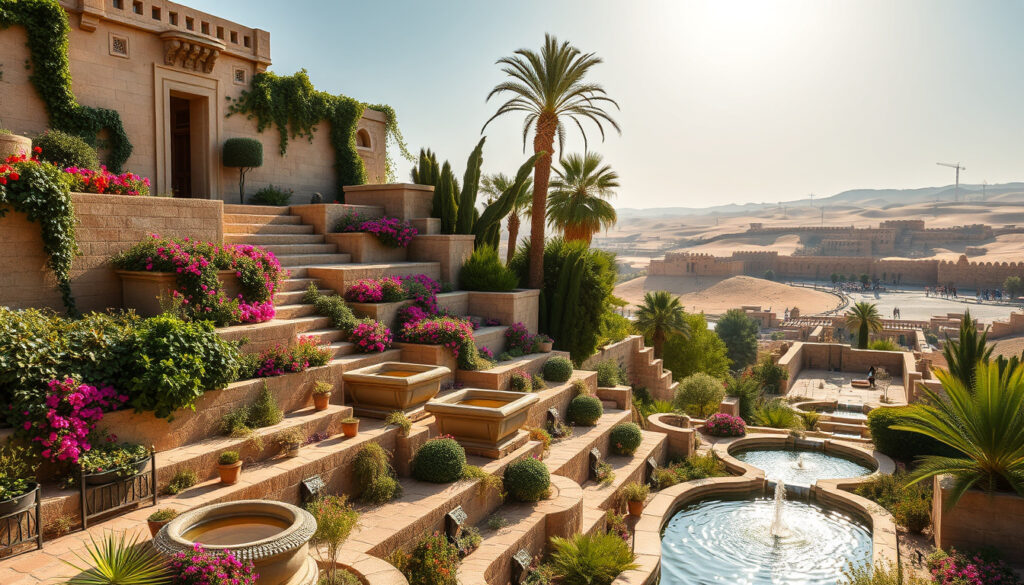
Hanging Gardens of Babylon: History, Mystery & Location
Few ancient wonders feel more like a rumor than a monument, and that is the strange appeal of the Hanging Gardens of Babylon. Greek and Roman writers described lush terraces raised above the desert, yet, as the World History Encyclopedia (ancient-history reference) notes, no Babylonian text and no definitively excavated site has ever confirmed them, leaving a mystery with no single solution that persists in its fascination.
Ancient Wonder Classification: Seven Wonders of the Ancient World ·
Presumed Builder: Nebuchadnezzar II (c. 605-562 BC) ·
Leading Alternative Site: Nineveh (Iraq) ·
Definitive Archaeological Proof: None discovered
Quick snapshot
- Babylon was a real and powerful city in ancient Iraq (Wikipedia (open encyclopedia)).
- Later tradition credits Nebuchadnezzar II with building the garden (Archaeology Magazine (field archaeology)).
- The exact location has never been conclusively established (Encyclopaedia Britannica (reference publisher)).
- Whether the Greek descriptions reflect a real structure or a literary ideal (Livius.org (ancient history site)).
- Herodotus wrote about Babylon without mentioning the gardens (University of Hamburg (manuscript studies)).
- An alternative timeline points to Sennacherib’s Nineveh around 700 BCE (World History Encyclopedia (ancient-history reference)).
- No excavation has yet closed the case at Babylon (World History Encyclopedia (ancient-history reference)).
- Dalley’s Nineveh theory continues to shape scholarly debate (National Geographic (science publisher)).
Eight facts, one pattern: the more specific the claim gets, the thinner the evidence becomes.
| Label | Value |
|---|---|
| Time Period | 6th century BCE, traditional (Encyclopaedia Britannica (reference publisher)) |
| Builder | Nebuchadnezzar II, according to later tradition (Archaeology Magazine (field archaeology)) |
| Location | Babylon, near modern Hillah, Iraq (Wikipedia (open encyclopedia)) |
| Alternative Location | Nineveh, Assyrian capital (National Geographic (science publisher)) |
| Status | Destroyed or never built; existence debated (Encyclopaedia Britannica (reference publisher)) |
| Primary Sources | Later Greek and Roman writers (Livius.org (ancient history site)) |
| Babylonian Record | No cuneiform text clearly mentions the gardens (Encyclopaedia Britannica (reference publisher)) |
| Archaeological Proof | None confirmed at Babylon (Wikipedia (open encyclopedia)) |
Is there any proof that the Hanging Gardens of Babylon existed?
What did ancient historians say about the gardens?
- The fullest surviving descriptions come from later Greek and Roman writers, not from Babylonian archives (Archaeology Magazine (field archaeology)).
- Herodotus wrote about Babylon in the 5th century BCE and never mentioned a hanging garden (University of Hamburg (manuscript studies)).
- The attribution to Nebuchadnezzar II was passed down by Flavius Josephus and became the standard story.
The gap matters: the earlier and closer the writer, the quieter the garden becomes.
Why do modern archaeologists doubt the traditional location?
- No cuneiform tablet from Babylon has been shown to describe a terraced garden complex.
- The city’s ancient monument list, TINTIR, does not include the gardens (Livius.org (ancient history site)).
- Excavations at Babylon have uncovered fortifications, palaces, and temples but no stratigraphic layer that matches a garden terrace.
That silence could mean the garden was simply outside Babylon’s official memorials, or it could mean the legend grew somewhere else.
What evidence points to Nineveh instead of Babylon?
- Stephanie Dalley argues that the gardens were built by Sennacherib at Nineveh, not by Nebuchadnezzar at Babylon (National Geographic (science publisher)).
- Sennacherib made Nineveh his capital around 700 BCE and surrounded it with canals and orchards.
- Nineteenth-century excavators found broken reliefs at Nineveh depicting tiered, tree-filled gardens.
The pattern: Babylon has the literary name; Nineveh has the archaeological pictures.
The most famous hanging garden in history may not have hung in Babylon at all.
The implication: the classical tradition may have preserved a real wonder, but attached it to the wrong city.
What does the Hanging Gardens of Babylon mean?
What is the meaning of the name ‘Hanging Gardens’?
- ‘Hanging’ describes terraced, elevated planting, not plants suspended in the air.
- The image of trees growing on top of stone vaults is what made the name vivid to later readers.
The label carried a promise of impossibility: greenery held aloft by architecture.
What did the gardens symbolize in ancient literature?
- For Greek and Roman writers, the garden represented a king’s mastery over nature.
- Green terraces above an arid plain made Babylon seem more powerful and more exotic.
That is why the garden kept appearing in texts even when no visitor could point to it.
How has the Hanging Gardens influenced art and culture?
- Later artists and writers used classical descriptions to imagine the gardens, giving Babylon a visual identity it might never otherwise have had.
- The phrase ‘Hanging Gardens’ remains shorthand for luxurious, engineered green space.
The implication: the miracle was always as much literary as architectural.
Who designed the Hanging Gardens of Babylon?
Was the design credited to Nebuchadnezzar II or a legendary queen?
- Flavius Josephus credited Nebuchadnezzar II, the Babylonian king of the sixth century BCE.
- No surviving Babylonian royal inscription links Nebuchadnezzar to such a garden.
- Later writers added romantic detail, but the contemporary record is silent.
The traditional story became popular because it was memorable, not because it was documented.
What were the engineering techniques behind the gardens?
- Ancient sources describe thick stone terraces supported by vaults and columns.
- The planting layers were sealed with baked brick, bitumen, and lead to stop water seeping through.
Even with those techniques, moving enough soil and water to grow mature trees would have been a massive project.
How did the irrigation system work?
- Classical authors were unsure how water reached the upper terraces; some mention screw-type pumps and chain pumps.
- Modern researchers debate whether such systems were available in Babylon in the sixth century BCE.
- In Dalley’s Nineveh model, an aqueduct system built by Sennacherib provides the water engineering.
What this means: the very details that make the legend compelling are the ones missing from the contemporary archive, fueling the search for a different origin.
Why is Hanging Gardens of Babylon a wonder?
Why was it considered one of the Seven Wonders of the Ancient World?
- Hellenistic travelers compiled lists of structures that were enormous, technically ambitious, and visually stunning.
- The garden fit because it seemed to reverse nature: trees on top of masonry, water moving upward.
The wonder was not just size; it was the visible overturning of the natural order.
How did it compare to other wonders like the Colossus of Rhodes?
- Other wonders, including the Colossus and the Mausoleum, had known sites; the Hanging Gardens did not.
- Where other wonders impressed by mass, the gardens impressed by horticulture and hydraulics.
That contrast made the garden the most imaginative item on the ancient list.
What makes its potential existence so awe-inspiring?
- A self-contained green mountain in a desert capital would have been a demonstration of nearly absolute royal power.
- The engineering required—terraces, drainage, lifts—would have stretched the technical limits of the ancient world.
Why this matters: the Hanging Gardens may be the only wonder whose power is inseparable from its uncertainty.
What country is considered Babylon today in the Bible?
Where is the city of Babylon located today?
- Babylon lies in modern Iraq, near the town of Hillah (Wikipedia (open encyclopedia)).
- The ancient site is not a modern city; it is an archaeological zone in Iraq’s central region.
So the Babylon of the Bible is the same place as the Babylon of the archaeological site.
Why did the Bible treat Babylon as a symbol of hubris?
- In biblical texts, Babylon is the empire that destroyed Jerusalem and carried the Jews into exile.
- It became shorthand for imperial arrogance and moral collapse.
That symbolic weight is one reason the Hanging Gardens story attached itself to Babylon so firmly.
What is the legacy of Babylon in modern Iraq?
- Saddam Hussein rebuilt parts of Babylon’s walls and palaces, signing bricks in imitation of Nebuchadnezzar.
- The ruins remain a major heritage destination in Iraq, even though the Hanging Gardens are still unconfirmed.
Why this matters: Babylon is not only an archaeological site; it is a symbol that different empires keep trying to claim.
Two cities, one garden: the Babylon case depends on later literature, while the Nineveh case depends on Assyrian images and waterworks.
| Question | Babylon theory | Nineveh theory |
|---|---|---|
| Where was it? | Babylon, near modern Hillah, Iraq | Nineveh, Sennacherib’s capital |
| Who built it? | Nebuchadnezzar II, per later tradition | Sennacherib, c. 700 BCE |
| What is the evidence? | Classical literary descriptions; no Babylonian text | Assyrian palace reliefs showing tiered gardens |
| Scholar’s view | Traditional Wonder; unconfirmed | Leading alternative hypothesis |
The trade-off: one city has the fame, the other has the pictures.
Timeline of the Hanging Gardens
- — Herodotus writes his Histories and describes Babylon without mentioning the gardens (University of Hamburg (manuscript studies)).
- — Stephanie Dalley argues publicly for Nineveh and Sennacherib (National Geographic (science publisher)).
What this means: the dates are stable on both sides, but the name and the location keep drifting apart.
What’s confirmed and what’s still unclear
What’s unclear
- Whether a terraced garden as described by Greek and Roman writers ever stood in Babylon.
- The exact location of the gardens if they did exist.
- The precise construction method, especially the irrigation system.
- Whether the classical descriptions preserved a real memory or a literary fantasy.
- The conventional date for Babylon’s rise under the first Babylonian dynasty (often cited as 1894–1595 BCE).
- The precise location and builder of the elaborate royal gardens at Nineveh in the early 7th century BCE.
- The traditional attribution of the gardens to Nebuchadnezzar II (c. 605–562 BCE).
- The exact circumstances of the Persian conquest of Babylon (traditionally 539 BCE).
- The reliability of the 1st century BCE account by Diodorus Siculus.
- Babylon’s status as a real city that became the center of a major empire.
- The fate of the city: conquered, abandoned, and partially excavated.
- The visibility of modern restorations on the site, including reconstructions associated with Saddam Hussein.
The pattern: the longer the legend runs, the more details it gains and the fewer physical traces it leaves.
Voices on the mystery
“The garden has plants cultivated above ground level, and the roots of the trees are embedded in an upper platform rather than in the earth.”
Diodorus Siculus, 1st century BCE (World History Encyclopedia (ancient-history reference))
“It consists of vaulted terraces raised one above another, and resting upon cube-shaped pillars.”
Strabo, Greek geographer (University of Hamburg (manuscript studies))
What this means: ancient authors shared the same core image, but none of them produced a contemporary Babylonian record.
Where the mystery stands
The Hanging Gardens of Babylon remain the only one of the Seven Wonders whose existence and location are both unconfirmed. The traditional story points to Nebuchadnezzar II and Babylon; the strongest modern alternative points to Sennacherib and Nineveh. For travelers hoping to see the gardens in Iraq, the honest answer is that you can walk through Babylon’s ruins, but the garden itself stays somewhere between memory, imagination, and archaeology.
Frequently asked questions
What are the Hanging Gardens of Babylon?
A legendary terraced garden complex described by later Greek and Roman writers and traditionally counted among the Seven Wonders of the Ancient World. No definitive Babylonian inscription or excavated remains have been conclusively identified.
Who built the Hanging Gardens?
Later tradition credits Nebuchadnezzar II, the Babylonian king of the sixth century BCE. Flavius Josephus preserved the attribution, but no surviving Babylonian text confirms it.
Are there any images of the Hanging Gardens?
No confirmed ancient image of the Babylon gardens is known. Nineteenth-century reliefs from Nineveh show tiered, tree-filled gardens, which Stephanie Dalley argued may depict the real model behind the legend.
How big were the Hanging Gardens?
Ancient sources give different dimensions, and no modern measurement is possible without a confirmed site. The surviving descriptions emphasize height, shade, and the heavy stone supports needed to hold the terraces.
Can I visit the Hanging Gardens today?
No. Visitors can see the ruins of Babylon in Iraq, but no structure has been identified as the Hanging Gardens.
Why is the Hanging Gardens the only wonder with uncertain existence?
It is the only one of the Seven Wonders not confirmed by archaeology and not mentioned in contemporary Babylonian texts. The evidence is literary, late, and open to competing interpretations.
Related reading
More related posts
 High Blood Pressure Treatment: Meds, Lifestyle & Quick Relief
 DCU St. Patrick’s Campus: Map, Location & Directions
 Benjamin Guinness: 3rd Earl of Iveagh Biography, Wealth
 Lilo & Stitch (2025 Film) – Guide to Release, Cast and Streaming
 Connolly Station Car Park: Prices, Booking, Safety & Hours
 Flu Symptoms for 3 Weeks Now: Causes and What to Do
 Best Coffee Machine with Grinder 2026: Reviews & Buying Guide
 Weather in Dublin Today: Current Conditions & Forecast
