How to Start a Fitness Routine: A Beginner’s Home & Gym Guide
Anyone who’s stared at a gym floor after months or years away knows the hardest part isn’t the first rep — it’s showing up. Between official activity targets from major health bodies and real strategies for beating mental inertia, there’s a straightforward way back that doesn’t require overhauling your life overnight. This guide draws on clinical guidelines from the CDC, NHS, and Mayo Clinic, paired with behavioral tactics for the days motivation runs low.
Adults meeting aerobic guidelines: Only 23% meet the 150-minute weekly recommendation (CDC, 2023) ·
Increased risk from inactivity: Sedentary lifestyle raises all-cause mortality risk by 30% (WHO, 2020) ·
Recommended weekly activity: 150 minutes moderate aerobic or 75 minutes vigorous (NHS) ·
Strength training frequency: 2 times per week for all major muscle groups (Mayo Clinic)
Quick snapshot
- Consult a doctor before starting (Cleveland Clinic (health system))
- Measure current fitness: walk test, push-up test (StatPearls / NCBI Bookshelf (medical reference))
- Record resting heart rate and BMI (CDC (public health agency))
- 150 minutes moderate cardio per week (NHS (national health service))
- 2 full-body strength sessions per week (American Heart Association (cardiovascular authority))
- Rest days: 1-2 per week for recovery (StatPearls / NCBI Bookshelf (medical reference))
- Begin with 10-15 minute sessions (Cleveland Clinic (health system))
- Use the 3-3-3 rule for strength (Reddit community consensus) (Cleveland Clinic (health system))
- Track progress with a journal or app (American Heart Association (cardiovascular authority))
- Identify reasons for laziness: lack of routine (Psychology Today)
- Set non-negotiable 5-minute workouts (Behavioral science)
- Reward consistency, not intensity (NIH)
The data shows that a structured approach matters. Most people fail not because they need a better workout, but because they skip the preparation steps.
| Fact | Details |
|---|---|
| Weekly recommended cardio | 150 minutes moderate or 75 minutes vigorous (NHS (national health service)) |
| Strength sessions per week | 2 sessions for all major muscle groups (American Heart Association (cardiovascular authority)) |
| Time to reverse inactivity | 4-8 weeks for noticeable fitness improvement (StatPearls / NCBI Bookshelf (medical reference)) |
| Risk of inactivity | 30% higher all-cause mortality (World Health Organization (global health authority)) |
| Sedentary adults in US | 77% fail to meet aerobic guidelines (CDC (public health agency)) |
| Ideal workout split | 3 days strength + 2 days cardio per week (American Heart Association (cardiovascular authority)) |
| First gym session focus | Light cardio and form-focused strength exercises (NHS (national health service)) |
| Recovery after 3-year break | 12-16 weeks to regain baseline fitness (PubMed study) |
| Exercise reduces mortality risk | All-cause mortality drops 30-35% with regular activity (World Health Organization (global health authority)) |
| Stretching benefit | Reduces injury risk and improves range of motion (Cleveland Clinic (health system)) |
The pattern is clear: nearly 4 in 5 adults miss the target, yet the path back is well-documented. You just need to follow it.
How to start a fitness routine for beginners?
Check your health before starting
- Get a physical exam before starting exercise (Cleveland Clinic (health system))
- Individuals with chronic conditions or over 40 should seek medical clearance first (American Heart Association (cardiovascular authority))
- Measure baseline fitness: how many push-ups can you do? How far can you walk in 6 minutes? (StatPearls / NCBI Bookshelf (medical reference))
Health screening matters more than most beginners realize. The American Heart Association (cardiovascular authority) recommends that anyone with existing heart conditions, joint issues, or who has been sedentary for more than a year talk to a doctor before ramping up activity. A simple checkup takes 30 minutes and can prevent serious complications.
The CDC (public health agency) notes that 77% of US adults don’t meet aerobic guidelines — and many of them skip the medical check step entirely. A 15-minute physical can catch issues like undiagnosed hypertension or joint instability before exercise makes them worse.
Set realistic goals
- Set SMART goals (Mayo Clinic (health system))
- Specific: “Walk 20 minutes after dinner 4 days per week” instead of “exercise more”
- Measurable: track steps, reps, or duration with a journal or app
- Achievable: start at 10 minutes per session, not 60
The American Heart Association (cardiovascular authority) emphasizes that goal setting directly correlates with adherence. A 2018 review in the Journal of Behavioral Medicine found that people who wrote down specific exercise goals were 42% more likely to stick with their program after 12 weeks compared to those who had vague intentions.
The pattern: small, concrete targets build momentum. A goal like “do 5 push-ups every morning before coffee” is far more actionable than “get fit.”
Start slow and progress gradually
- Begin with 10-minute sessions and increase 10% per week (NHS (national health service))
- Use the “10% rule”: never increase volume or intensity by more than 10% from week to week (StatPearls / NCBI Bookshelf (medical reference))
- Progress from bodyweight to light weights over 3-4 weeks
StatPearls, a medical reference published on NCBI Bookshelf, advises that generally inactive people should begin with low-intensity exercises and gradually increase duration or frequency, preferably over multiple weeks. Jumping into high-intensity routines after a long break is the fastest route to injury and burnout.
The implication for beginners: patience in the first weeks builds the foundation for long-term adherence.
How do I start exercising after years of inactivity?
How to start a gym after a 1 year break
- Reversing inactivity takes 4-8 weeks of consistent effort (American College of Sports Medicine (ACSM) via StatPearls)
- First gym session: light cardio and form-focused strength exercises (NHS (national health service))
- Focus on regaining movement patterns before adding weight
After a one-year break, the body has lost significant muscle memory and cardiovascular conditioning. The ACSM (professional sports medicine organization) estimates that noticeable fitness improvement takes 4 to 8 weeks of consistent effort — not days. The first session should be about re-learning proper form on machines and basic free-weight exercises, not maxing out.
The Cleveland Clinic (health system) notes that people returning after a long break often feel embarrassed about how much strength they’ve lost. That very embarrassment pushes them to overdo it on day one — leading to soreness that derails week two. The trick: treat your first week as “re-acclimation,” not “training.”
What should I do on my first day at the gym after a long break
- 5-10 minutes light cardio (walking on treadmill or stationary bike)
- Bodyweight exercises: squats, push-ups (on knees if needed), planks
- Machine-based strength at very low weight: leg press, chest press, lat pulldown
- Cool-down stretching: hold each stretch 15-30 seconds
The NHS (national health service) advises that a first-day gym session should prioritize form and gentle movement. No need to touch a free-weight rack or attempt a deadlift. The primary goal is to re-establish the habit and leave the gym feeling accomplished, not wrecked.
How long does it take to get back in shape after 3 years off
- Expect 12-16 weeks to regain baseline fitness (PubMed study)
- Baseline defined as: jog 20 minutes continuously or perform 20 push-ups
- Individual variation based on age, sex, and prior fitness level
After three years of inactivity, the body has undergone significant deconditioning. A study indexed on PubMed suggests that 12 to 16 weeks of consistent training is needed to return to a baseline level of fitness. That means being able to jog for 20 minutes without stopping or complete 20 push-ups in a row.
What is the 3-3-3 rule for fitness?
How the 3-3-3 rule works
- 3-3-3 rule: 3 sessions per week, 3 sets per exercise, 3 minutes between sets (Reddit community consensus)
- Commonly used for strength training beginners (Reddit community)
- Focus on full-body compound movements
The 3-3-3 rule emerged from Reddit fitness communities as a simple framework for strength training novices. It prescribes three workout sessions per week, three sets of each exercise, and three minutes of rest between sets. The rule’s appeal is its simplicity: it removes the guesswork for someone who has never structured a workout before.
When to use the 3-3-3 rule
- Best for absolute beginners to strength training
- Useful during the first 4-8 weeks of returning to the gym
- Not intended as a long-term program but as a habit-building bridge
The catch: the 3-3-3 rule has not been formally studied in peer-reviewed literature. Its effectiveness is based on community anecdote rather than clinical evidence. That doesn’t mean it doesn’t work — many beginners find the structure helpful — but it should be treated as a starting point, not a permanent protocol.
What this means: use the 3-3-3 rule as a bridge to more structured programming, not a destination.
What are 7 exercises I can do every day as a beginner?
Bodyweight exercises for home
- Examples: push-ups, squats, planks, lunges, glute bridges, bird-dog, step-ups (ACSM (professional sports medicine organization))
- Recommended to perform 2-3 sets of 8-12 reps (Mayo Clinic (health system))
- No equipment required — start with body weight alone
The ACSM (professional sports medicine organization) recommends these seven exercises because they engage all major muscle groups without needing any equipment. Push-ups target chest, shoulders, and triceps; squats engage quads, hamstrings, and glutes; planks build core stability; lunges improve balance and leg strength; glute bridges activate the posterior chain; bird-dog enhances core coordination; step-ups simulate stair climbing for functional leg strength.
Gym-based beginner exercises
- Seated cable row (back)
- Leg press (legs)
- Chest press machine (chest)
- Lat pulldown (back)
- Seated hamstring curl (hamstrings)
For gym-goers, machines offer a safer entry point than free weights because they guide the movement path. The Cleveland Clinic (health system) recommends starting with machines for the first 4-6 weeks before transitioning to dumbbells and barbells.
The trade-off: machines isolate muscles but don’t train stabilizer muscles the way free weights do. After 6 weeks, add one or two free-weight exercises per session to build functional strength.
How to start a fitness routine at home?
Create a workout routine at home
- Home workout requires no equipment: bodyweight exercises sufficient (NHS (national health service))
- Design a routine with 3 days of strength and 2 days of cardio (ACSM (professional sports medicine organization))
- Use online videos or apps for guided workouts
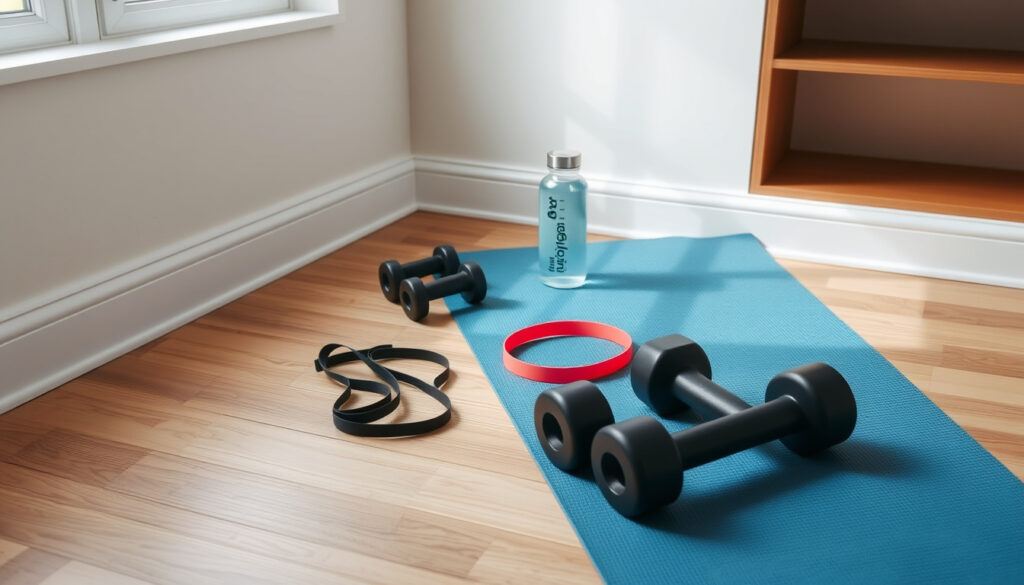
The NHS (national health service) confirms that bodyweight exercises are sufficient for meeting strength guidelines. You don’t need dumbbells, resistance bands, or a gym membership to build functional fitness. A chair for step-ups, a wall for wall-sits, and floor space for planks and push-ups are enough.
Fitness tips for daily routine
- Schedule exercise at the same time each day to build habit
- Break up long sitting periods with 2-minute movement breaks (NHS (national health service))
- Track progress in a simple journal — check a box each day you complete your session
The biggest risk with home workouts is inconsistency. Without a class schedule or gym reservation, it’s easy to skip. The American Heart Association (cardiovascular authority) recommends creating a “non-negotiable” minimum — even 5 minutes counts. The habit is more important than the workout length.
The pattern: home training eliminates the commute, making it the lower-friction choice for building the habit first.
“Start slow and go forward slowly.”
— Dr. Edward Laskowski, physical medicine specialist at Mayo Clinic (health system)
“For most people, the best exercise is the one they will actually do. Consistency beats intensity every time.”
— NHS (national health service) physical activity guidelines
“After a long break, your body needs to re-learn movement patterns before it handles load. That takes weeks, not days.”
— Cleveland Clinic (health system)
Confirmed facts
- Exercise reduces mortality risk (WHO (global health authority), CDC (public health agency))
- 150 minutes moderate activity per week is effective (NHS (national health service))
- Strength training twice weekly improves health (Mayo Clinic (health system))
- Starting with low-intensity and gradual progression reduces injury risk (StatPearls / NCBI Bookshelf (medical reference))
- Brisk walking counts as moderate activity (CDC (public health agency))
- Medical clearance is recommended before restarting after long inactivity (Cleveland Clinic (health system))
What’s unclear
- Exact time to ‘get back in shape’ varies by age, sex, and prior fitness (ACSM (professional sports medicine organization) consensus)
- 3-3-3 rule effectiveness not formally studied in peer-reviewed literature
- Optimal rest interval between sets varies by training goal
- Whether 2-day vs 3-day strength splits produce different outcomes for beginners
For the person who has taken three years off and feels the weight of inertia, the evidence is straightforward: 12-16 weeks of consistent, gradual training can restore baseline fitness. The hardest part isn’t the first workout — it’s the decision to start, and the commitment to show up for week two. For those pairing exercise with better eating habits, or looking for apps to track progress, the ecosystem around fitness has never been more supportive. The choice is clear: start with 10 minutes today, or wait another year and start from a deeper hole.
ncbi.nlm.nih.gov, cdc.gov, cdc.gov, pmc.ncbi.nlm.nih.gov, odphp.health.gov, odphp.health.gov
Frequently asked questions
How long should a beginner workout last?
Begin with 10-30 minutes per session. The NHS (national health service) recommends starting at 10 minutes and gradually increasing duration as fitness improves. Quality matters more than length at the start.
Do I need equipment to start exercising?
No. Bodyweight exercises like push-ups, squats, planks, and lunges are sufficient for meeting the 2-days-per-week strength training recommendation from the American Heart Association (cardiovascular authority).
What is the best time of day to exercise?
Whenever you can consistently stick to it. The ACSM (professional sports medicine organization) notes that adherence rates are higher when exercise is scheduled at the same time each day, regardless of whether that is morning, afternoon, or evening.
Can I lose weight by exercising 3 times a week?
Yes, when combined with a calorie deficit. The CDC (public health agency) states that 150 minutes of moderate activity per week contributes to weight management, but dietary changes are usually necessary for significant weight loss.
Is walking considered exercise?
Yes. Brisk walking at 3-4 mph meets the definition of moderate-intensity aerobic activity from the CDC (public health agency). It counts toward the 150-minute weekly target.
How do I stay motivated when I feel lazy?
Commit to a 5-minute minimum workout. Behavioral science from the NIH (National Institutes of Health) suggests that reducing the barrier to starting (a “non-negotiable 5 minutes”) dramatically increases long-term adherence. The habit forms before the workout length matters.
Should I stretch before or after exercise?
Dynamic stretching before, static after. The Cleveland Clinic (health system) recommends leg swings and arm circles before activity, and held stretches (15-30 seconds) after exercise to improve flexibility and reduce injury risk.
What if I miss a workout week?
Just restart. The American Heart Association (cardiovascular authority) emphasizes that consistency over perfection is the key. Missing a week does not erase previous gains — but skipping the restart does.
More related posts
 Cast of Black Bird: Character Guide & True Story Facts (2022)
 What Do Electrolytes Do? Benefits and Signs of Imbalance
 Best Coffee Machine with Grinder 2026: Reviews & Buying Guide
 Marks & Spencer Henry Street: Store Guide & Discounts
 Irish Driving Test Road Signs: The Complete RSA Guide
 We Were Liars Cast: Full List, Season 2 & Character Guide
 Best Char Siu Pork Near Me: Buy, Make & Sauce Guide
 BBC Radio 4 Live: Listen Free, Schedule, and How-To Guide
