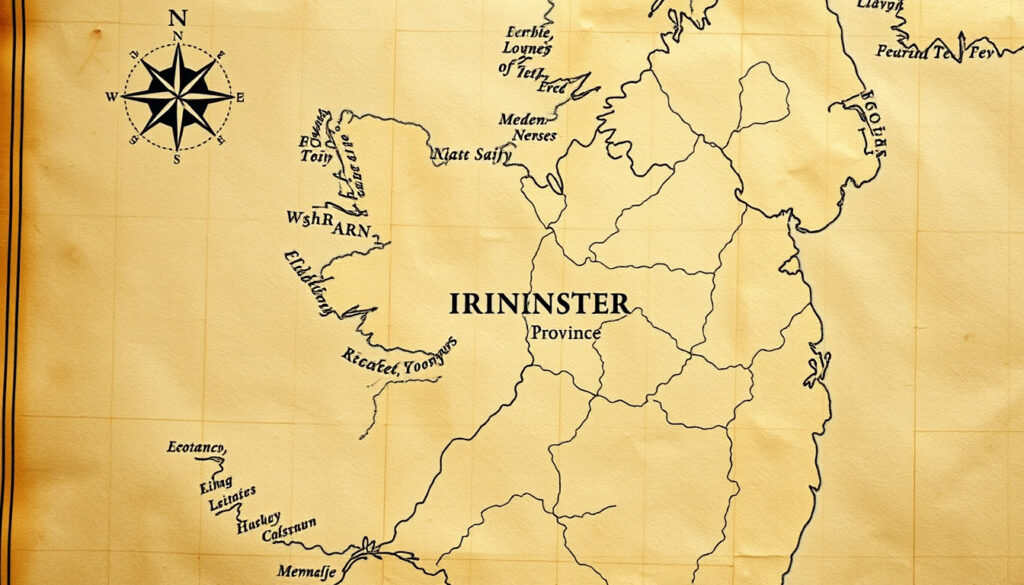
What Province is Dublin In? Leinster & Ireland’s Provinces
Ireland’s four provinces shape its identity, and Dublin’s place within Leinster connects the capital to a system of medieval kingdoms that still matters today. Understanding this reveals how modern Ireland still reflects its medieval roots.
Dublin is in the province of: Leinster ·
Number of provinces in Ireland: 4 ·
Counties in Leinster: 12 ·
Population of Dublin (2022): 1.5 million ·
Capital of Ireland: Dublin
Quick snapshot
- Dublin is in Leinster (Ireland.com official tourism)
- Ireland has 4 provinces (Britannica)
- Leinster has 12 counties (Wikipedia)
- Dublin is the capital of Ireland (Britannica)
- Ancient boundaries of the fifth province of Meath (Library Ireland)
- Exact match between pre-Norman and modern provincial borders (Library Ireland)
- Provinces remain GAA sports divisions (GAA official)
- Local government uses regions, not provinces (Gov.ie)
Seven key facts at a glance, one pattern: Dublin sits at the intersection of Ireland’s ancient territorial system and its modern administrative map.
| Fact | Value |
|---|---|
| City | Dublin |
| Country | Ireland |
| Province | Leinster (Ireland.com official tourism) |
| Irish name | Baile Átha Cliath (Logainm.ie official place names) |
| County | County Dublin (historic) |
| Established as city | 9th century (Viking settlement) (Britannica) |
| Population (city proper) | 1.5 million (2022 census) (CSO Ireland census data) |
What province is Dublin, Ireland in?
Dublin’s location within Leinster
Dublin, the capital of Ireland, is located in the province of Leinster on the east coast at the mouth of the River Liffey (Britannica geography entry). The city sits on Dublin Bay, and its position within Leinster has made it the political, economic, and cultural heart of the region for centuries. Leinster is the most populous of Ireland’s four provinces, home to over 2.8 million people — more than half the Republic’s population.
Leinster’s counties and key cities
Leinster comprises 12 traditional counties, with Dublin as its capital city. The complete list includes Carlow, Dublin, Kildare, Kilkenny, Laois, Longford, Louth, Meath, Offaly, Westmeath, Wexford, and Wicklow (Ireland.com counties and provinces guide). Other major cities within the province include Kilkenny, a historic medieval city, and Drogheda, though Dublin is the only official city in Leinster by legal designation (Wikipedia Leinster page).
The implication: Dublin’s identity as a provincial capital within Leinster is not just a technical geographic fact — it reflects a historical unity that predates the modern Irish state.
What are the 4 provinces of Ireland?
Leinster
- Capital: Dublin
- Counties: 12
- Population: ~2.8 million
- Famous for: Dublin city, the Pale, ancient East (Britannica)
Munster
- Capital: Cork
- Counties: 6
- Population: ~1.3 million
- Famous for: Ring of Kerry, Cliffs of Moher (Britannica)
Connacht
- Capital: Galway
- Counties: 5
- Population: ~550,000
- Famous for: Connemara, Wild Atlantic Way (Britannica)
Ulster
- Capital: Belfast (Northern Ireland)
- Counties: 9 (3 in Republic, 6 in NI)
- Population: ~2.1 million
- Famous for: Giant’s Causeway, Titanic Belfast (Britannica)
Each province has a distinct cultural identity — Leinster is the political and economic heavyweights, Munster the scenic south, Connacht the wild west, and Ulster the partitioned north with a contested history.
Four provinces, one clear division: each has a distinct geography, economy, and cultural character that has shaped Ireland’s regional identity.
| Province | Capital | Number of counties | Population |
|---|---|---|---|
| Leinster | Dublin | 12 | ~2.8 million (CSO Ireland) |
| Munster | Cork | 6 | ~1.3 million (CSO Ireland) |
| Connacht | Galway | 5 | ~550,000 (CSO Ireland) |
| Ulster | Belfast | 9 | ~2.1 million (CSO Ireland) |
Why this matters: Dublin’s province — Leinster — holds the majority of Ireland’s population and GDP, giving the city an outsized role within the provincial system.
What province is Dublin in Irish?
Irish name for Dublin
Dublin’s Irish name is Baile Átha Cliath, which means “town of the hurdled ford” (Logainm.ie official place names database). The name refers to the original settlement at a ford crossing the River Liffey.
Irish name for Leinster
Leinster in Irish is Cúige Laighean — “the province of the Laigin,” the ancient tribe that inhabited the region (AskAboutIreland.ie educational resource). The word cúige literally means “fifth,” a remnant of the time when Ireland had five provinces.
Other provinces in Irish
- Munster: Cúige Mumhan
- Connacht: Cúige Chonnacht
- Ulster: Cúige Uladh
These Irish names connect modern provinces directly to their Gaelic roots, each referencing a historic tribe or region (Royal Irish Academy place-name research).
The pattern: these Irish names preserve tribal identities that have defined Irish regions for over a thousand years.
What region is Dublin in?
Region vs province in Ireland
In everyday Irish usage, “region” and “province” are often used interchangeably when referring to Leinster, Munster, Connacht, and Ulster. However, there’s a technical distinction: provinces are traditional cultural divisions, while the term “region” also refers to modern administrative areas like the Eastern and Midland Region established by local government reform (Gov.ie regional government guide).
Dublin’s administrative region
The Dublin Region is a separate administrative concept that covers the city and county of Dublin (now subdivided into Dublin City, Dún Laoghaire-Rathdown, Fingal, and South Dublin). This region is often called “the Greater Dublin Area” and includes parts of neighboring counties like Kildare, Meath, and Wicklow (CSO Ireland regional data).
The catch: While Leinster is Dublin’s province, the Dublin Region is the functional economic and administrative unit that matters for planning, transport, and housing policy.
What is a province of Ireland?
Historical origin of Irish provinces
Ireland’s provinces date back to medieval Gaelic kingdoms called tuatha, which were consolidated into larger regional kingdoms by the 5th century. Originally there were five cúige — Ulster, Munster, Connacht, Leinster, and Meath (Mide) — before Meath was absorbed into Leinster (Library Ireland historical reference). This fifth province has never been fully extinguished in cultural memory.
Provinces vs counties
- Provinces: 4 traditional divisions, no administrative function today
- Counties: 32 primary administrative divisions (26 in Republic, 6 in Northern Ireland)
- Provinces are used for sports (GAA), cultural identity, and regional pride
- Counties handle local government, postal addresses, and land registration
The difference matters because when someone asks “What province is Dublin in?” they’re asking about cultural geography, not administrative boundaries. Dublin is unequivocally in Leinster on both maps and in historical records (Wikipedia County Dublin page).
Tourists and newcomers who learn the provinces get a richer understanding of Irish culture — but anyone navigating modern Ireland will find that counties and regions are far more practical for day-to-day business.
The implication: choosing to say ‘province’ vs ‘county’ reveals whether you’re talking about cultural heritage or practical administration.
Confirmed facts about Ireland’s provinces
- Dublin is in the province of Leinster (Ireland.com official tourism).
- Ireland has four provinces (Britannica).
- Leinster contains 12 counties (Wikipedia).
- Dublin is the capital of Ireland (Britannica).
- County Dublin was split into 4 administrative areas in 1994 (Wikipedia).
What’s unclear about Ireland’s provinces
- The exact boundaries of the ancient fifth province of Meath are debated (Library Ireland).
- Whether pre-Norman province boundaries exactly match modern borders is uncertain (Library Ireland).
Dublin is the capital and largest city of Ireland. Situated on Dublin Bay at the mouth of the River Liffey, it is in the province of Leinster.
— Wikipedia Dublin article
Dublin, the capital of Ireland, is located on the east coast in the province of Leinster.
— Britannica entry for Dublin
Carlow, Dublin, Kildare, Kilkenny, Laois, Longford, Louth, Meath, Offaly, Westmeath, Wexford and Wicklow are the counties that make up the Leinster region.
— Ireland.com counties and provinces guide
wesleyjohnston.com, greenwayhub.ie, commons.wikimedia.org, familysearch.org, ezilon.com, pinterest.com, en.wikipedia.org, libguides.ucd.ie
Visitors often ask which province Dublin belongs to, and Irelands four provinces provides a detailed look at the historical and modern divisions.
Frequently asked questions
What is the population of Dublin?
1.5 million (2022 census) (CSO Ireland).
What does ‘cúige’ mean in Irish?
Cúige means “fifth,” referring to the five original provinces of Ireland (Royal Irish Academy).
Is Dublin City the same as County Dublin?
No. County Dublin was abolished as an administrative unit in 1994 and split into Dublin City, Dún Laoghaire–Rathdown, Fingal, and South Dublin (Wikipedia).
What is the Dublin Region?
The Dublin Region is a modern administrative area covering the city and county of Dublin, often called the Greater Dublin Area (Gov.ie).
How many provinces does the Republic of Ireland have?
The Republic of Ireland has four provinces: Leinster, Munster, Connacht, and part of Ulster (3 of its 9 counties are in the Republic) (Ireland.com).
For students, travelers, and diaspora members, the four provinces provide the cultural map, while the 32 counties deliver the practical detail needed for modern Ireland.
More related posts
 Made by Mitchell Curve Case Review & Variant Guide
 Brighton vs Crystal Palace: Rivalry, H2H Stats & Results
 How to Lower Blood Pressure: Quick Fixes & Long-Term Plan
 Aston Villa vs Manchester United F.C. Timeline: H2H History
 How to Stop a Nosebleed: First Aid, Causes & When to Seek Help
 Oud-Heverlee Leuven vs Arsenal: How to Watch & Preview
 How to Say Good Morning in Italian: All Expressions & Pronunciations
 Best Baby Strollers 2025 – Lab-Tested Top Picks
