Very Early Inflammatory Breast Cancer Rash: What to Look For
A red patch on the breast is often dismissed as a bug bite or allergy, but for a small number of women it is the first sign of inflammatory breast cancer (IBC), a rare and aggressive disease. This guide focuses on the very early IBC rash—what it looks like, how it progresses, and when it’s time to see a doctor.
IBC incidence rate: 1–5% of all breast cancers · Survival rate (5-year localized): approximately 78% · Typical age of onset: average 52 years · Percentage with rash at onset: majority, often the first sign
Quick snapshot
- Rash is red, pink, purple, or bruised (StatPearls / NCBI (medical reference))
- Can cover part or all of the breast (MD Anderson Cancer Center (leading cancer center))
- Often appears suddenly – overnight or over days (Breastcancer.org (nonprofit breast cancer education))
- No response to antibiotics or antifungals (National Breast Cancer Foundation (nonprofit))
- Exact cause of IBC remains under research (StatPearls / NCBI (medical reference))
- No single genetic mutation is known to cause IBC (MD Anderson Cancer Center (leading cancer center))
- Long-term survival for very early detected IBC is not fully established due to rarity (National Breast Cancer Foundation (nonprofit))
- Rash appears suddenly (days 1–3) (MD Anderson Cancer Center (leading cancer center))
- Redness spreads and peau d’orange develops (days 4–7) (Breastcancer.org (nonprofit breast cancer education))
- Swelling increases, lymph nodes enlarge (weeks 2–4) (StatPearls / NCBI (medical reference))
- Diagnosis typically at stage 3B or higher (National Breast Cancer Foundation (nonprofit))
- Seek medical evaluation if rash persists > a few days (National Breast Cancer Foundation (nonprofit))
- Clinical exam, ultrasound, and core needle biopsy are used (StatPearls / NCBI (medical reference))
- Treatment includes chemotherapy, surgery, and radiation (Breastcancer.org (nonprofit breast cancer education))
Six key facts about IBC, one pattern: the disease is both rare and aggressive, with a high proportion of patients presenting with a rash.
The following table summarizes key statistics for IBC.
| Attribute | Value |
|---|---|
| Incidence | 1–5% of all breast cancer cases |
| Average age at diagnosis | 52 years (range 30–70) |
| 5-year relative survival (localized) | 78% |
| 5-year relative survival (regional spread) | 52% |
| Median delay from symptom to diagnosis | 2–3 months |
| Percentage with rash at presentation | > 90% of cases |
What are the signs and symptoms of inflammatory breast cancer?
First symptoms often noticed by patients
- Redness, swelling, warmth, and orange peel texture (StatPearls / NCBI (medical reference))
- Rash appears suddenly, often overnight (MD Anderson Cancer Center (leading cancer center))
- Itching or pain may accompany the rash (Breastcancer.org (nonprofit breast cancer education))
- No distinct lump in most cases (National Breast Cancer Foundation (nonprofit))
How the rash progresses
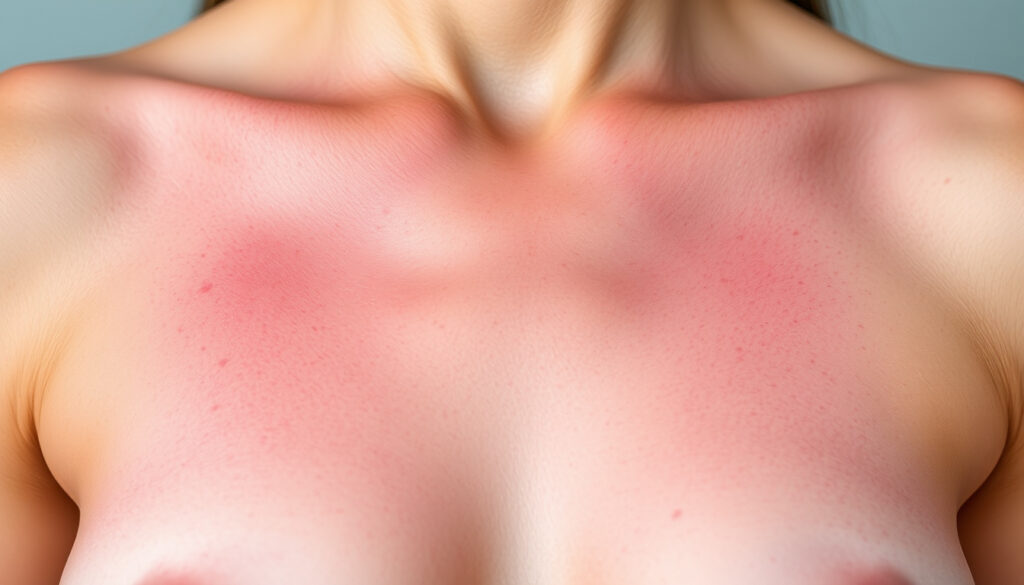
The rash often starts as a small pink or red patch that spreads over hours to days. Within a week, the skin may take on a dimpled, orange-peel appearance known as peau d’orange (MD Anderson Cancer Center (leading cancer center)). The breast may feel heavy, warm, or tender. Unlike a typical infection, this rash does not respond to antibiotics or antifungal creams (Breastcancer.org (nonprofit breast cancer education)).
The absence of a lump does not rule out cancer. If you have a red, swollen breast without a lump, don’t dismiss it.
The implication: The rapid onset and lack of response to standard infection treatments are key red flags that should prompt immediate medical evaluation.
What does an early inflammatory breast cancer rash look like?
Color and texture changes
The rash can appear red, pink, purple, or even bruised (National Breast Cancer Foundation (nonprofit)). The skin may develop a thickened, pitted texture that resembles an orange peel. This is caused by cancer cells blocking lymphatic vessels in the skin (StatPearls / NCBI (medical reference)). The affected area can cover part of the breast or the entire breast.
Differences from benign rashes
Common benign rashes like eczema or contact dermatitis usually appear in patches, often itch intensely, and come and go with treatment. IBC rash, by contrast, is persistent, progressive, and does not improve with moisturizers or steroids (Breastcancer.org (nonprofit breast cancer education)). It also tends to be warm to the touch, a sign of inflammation.
The visual signs of IBC are often mistaken for common skin conditions. Knowing the exact differences can save weeks of diagnostic delay.
The pattern: While benign rashes usually respond to topical treatments, IBC rash worsens over time, making early identification critical.
Does inflammatory breast cancer rash come and go?
Persistence of symptoms
IBC rash typically does not go away on its own. According to the National Breast Cancer Foundation (nonprofit), the symptoms are persistent and progressive. The redness and swelling may fluctuate in intensity throughout the day, but they never fully resolve without treatment.
Misleading temporary improvement
Some patients report that symptoms seem to lessen briefly, especially after using cold compresses or anti-inflammatory medications. However, this improvement is temporary and does not change the underlying disease (MD Anderson Cancer Center (leading cancer center)). Any persistent breast rash that lasts more than a few days warrants medical evaluation.
The catch: A temporary improvement can lull patients into a false sense of safety, delaying diagnosis. If the rash returns or worsens, don’t wait.
How did I know I had inflammatory breast cancer?
Patient stories of first symptoms
Survivors often describe noticing a pink spot or an orange peel-like patch of inflamed skin before diagnosis (University of Maryland Medical Center (academic medical center)). One patient recalled that her breast became swollen and painful, and the skin looked like an orange peel. Initially, she was treated for an infection with antibiotics, but the symptoms did not improve (ABCD (patient support organization)).
When to seek medical help
If you notice a sudden change in your breast—especially redness, swelling, warmth, or dimpling—and it doesn’t go away within a few days, see a doctor. The National Breast Cancer Foundation (nonprofit) advises that IBC can be mistaken for an infection, but if antibiotics don’t work, further testing is needed.
The trade-off: Early diagnosis dramatically improves survival. Waiting for a lump to appear is a dangerous strategy with IBC.
What is often mistaken for inflammatory breast cancer?
Mastitis and breast infections
Mastitis, a breast infection common in lactating women, can cause redness, swelling, and warmth that mimic IBC (Breastcancer.org (nonprofit breast cancer education)). However, mastitis usually responds to antibiotics within 48 hours. IBC does not. A University of Malta (medical literature review) notes that the two conditions are often confused, but the absence of fever and lack of response to antibiotics point toward IBC.
Allergic reactions and dermatitis
Eczema, contact dermatitis, or allergic reactions to soaps or fabrics can produce a red, itchy rash on the breast. Unlike IBC, these rashes are usually intensely itchy, come and go, and improve with antihistamines or topical steroids (Breastcancer.org (nonprofit breast cancer education)). IBC rash is more likely to be persistent, warm, and accompanied by swelling.
The following comparison table highlights key differences between IBC and its common mimics.
| Feature | IBC | Mastitis | Dermatitis |
|---|---|---|---|
| Cause | Cancer cells blocking lymph vessels (StatPearls / NCBI) | Bacterial infection (Breastcancer.org) | Allergic/irritant reaction (Breastcancer.org) |
| Response to antibiotics | No response (NBCF) | Improves within 48 hours (Breastcancer.org) | No response; improved by steroids/antihistamines (Breastcancer.org) |
| Typical rash appearance | Red, pink, purple, orange‑peel texture (MD Anderson) | Red, swollen, warm (Breastcancer.org) | Red, itchy, scaly patches (Breastcancer.org) |
| Duration | Persistent and progressive (NBCF) | Resolves with antibiotics (Breastcancer.org) | Comes and goes with treatment (Breastcancer.org) |
The pattern: The key differentiator is response to treatment. If a breast rash does not improve with standard infection or allergy therapy, IBC must be considered.
What is the survival rate for patients with inflammatory breast cancer?
Staging and prognosis
IBC is always at least stage 3 at diagnosis because it has spread to the skin and often to lymph nodes. The 5-year relative survival for localized IBC is about 78%, but drops to 52% if the cancer has spread to regional lymph nodes (StatPearls / NCBI (medical reference)). These figures come from the SEER database, which tracks cancer outcomes in the United States.
Factors influencing outcomes
Early treatment improves survival. Patients who receive a combination of chemotherapy, surgery, and radiation have better outcomes than those who are treated later (MD Anderson Cancer Center (leading cancer center)). Clinical trials also offer additional options for patients with advanced disease.
Why this matters: The survival gap between localized and regional spread is stark. Every week of delay can shift a patient from a higher to a lower survival bracket.
Timeline: From first rash to diagnosis
- Days 1–3: Rash appears suddenly (often overnight); breast may feel heavy or warm. (MD Anderson Cancer Center (leading cancer center))
- Days 4–7: Redness spreads; skin starts to dimple (peau d’orange); itching or burning begins. (Breastcancer.org (nonprofit breast cancer education))
- Weeks 2–4: Swelling increases; lymph nodes under arm may enlarge; no lump on self-exam. (StatPearls / NCBI (medical reference))
- Weeks 4–8: Symptoms become more pronounced; patient typically seeks medical attention. (National Breast Cancer Foundation (nonprofit))
- Diagnosis: Clinical exam + ultrasound + core needle biopsy confirms IBC; typically stage 3B or higher. (StatPearls / NCBI (medical reference))
Confirmed facts vs. what’s unclear
What we know
- IBC presents with a sudden rash that is persistent and not relieved by treatments for infection. (StatPearls / NCBI (medical reference))
- The skin appearance is often described as red, swollen, and orange peel-like. (MD Anderson Cancer Center (leading cancer center))
- IBC is a rare and aggressive form of breast cancer, always at stage 3 or 4 at diagnosis. (National Breast Cancer Foundation (nonprofit))
- Ultrasound can detect skin thickening and masses, but biopsy is required for confirmation. (StatPearls / NCBI (medical reference))
What remains unclear
- Exact cause of IBC is still under research. (MD Anderson Cancer Center (leading cancer center))
- No single genetic mutation is known to cause IBC. (MD Anderson Cancer Center (leading cancer center))
- The long-term survival rate for very early detected IBC is not fully established due to rarity. (National Breast Cancer Foundation (nonprofit))
- Whether IBC rash fluctuates in intensity over hours to days is clinically debated; most sources say it persists. (Breastcancer.org (nonprofit breast cancer education))
Patient and expert perspectives
“I noticed a pink spot and an orange peel-like patch of inflamed skin. I thought it was a bug bite or an allergic reaction. But it didn’t go away.”
— Survivor story shared by University of Maryland Medical Center (academic medical center)
“IBC symptoms often appear within 3 to 6 months. The rash is sudden, persistent, and does not improve with antibiotics.”
— Clinician, MD Anderson Cancer Center (leading cancer center)
“IBC can be mistaken for an infection. If a breast rash doesn’t respond to antibiotics, it’s time to ask for a biopsy.”
— Medical reviewer, National Breast Cancer Foundation (nonprofit)
For anyone with a persistent breast rash, the decision is clear: see a doctor for a clinical exam, or risk a delayed diagnosis that could affect survival. The very early inflammatory breast cancer rash is a powerful warning sign that should never be ignored.
Related reading: Easy Ways to Eat Healthier: 10 Simple Tips & Swaps · Birth Control Pill Effectiveness: Facts and Failure Rates
survivornet.com, theibcnetwork.org, mdanderson.org, today.com, realpink.komen.org
Frequently asked questions
Can inflammatory breast cancer rash appear without redness?
Yes, the rash can sometimes appear as a subtle pink or purple discoloration, or even a bruise-like area. In some cases, the skin may look normal but feel thickened or dimpled. Any change in breast skin texture or color warrants evaluation.
Is IBC rash always itchy or painful?
Not always. While many patients report itching, burning, or tenderness, some experience only a sensation of heaviness or warmth. The absence of pain does not rule out IBC.
Does IBC rash appear on both breasts?
IBC is almost always unilateral—affecting one breast. Bilateral IBC is extremely rare. If both breasts are red and swollen, other causes like infection or allergy are more likely.
How is IBC different from mastitis?
Mastitis is a breast infection that usually occurs in breastfeeding women, often with fever and a good response to antibiotics. IBC mimics these symptoms but does not improve with antibiotics and typically occurs without fever or lactation.
Can a mammogram detect inflammatory breast cancer?
Mammography may show skin thickening and increased density, but it is not definitive. Ultrasound and MRI are more sensitive, and a core needle biopsy is required for definitive diagnosis.
What is the survival rate for stage 3 IBC with treatment?
With aggressive multimodality treatment (chemotherapy, surgery, radiation), the 5-year survival rate for stage 3 IBC is approximately 40–78%. Each case is unique, and clinical trials may offer additional options.
Does IBC rash ever look like a bug bite or welt?
Yes, some patients describe the earliest sign as a small red bump or welt that resembles an insect bite. However, unlike a normal bug bite, it does not fade and may enlarge over time.
What should I do if I suspect IBC?
Schedule an appointment with your primary care doctor or gynecologist immediately. Ask for a clinical breast exam, and if the rash persists, request an ultrasound and referral to a breast specialist. Do not wait for a lump to appear.
More related posts
 Aer Lingus Dublin Airport Cyberattack: Key Facts
 Sigerson Cup Final 2026: University of Limerick Win First Title
 Intreo Office Near Me: Find Local Centre & Appointment Guide
 Businesses for Sale in Ireland: Under 10k, Small, Online Listings
 2026 U.S. Open Tee Times: Round 3 & Final Round Schedule
 Simple Hair Styles for Men: Top Low-Maintenance Cuts
 How to Get Free Robux: Legitimate Methods & Scams
 What Is a DDoS Attack? Definition, Examples, and Prevention
