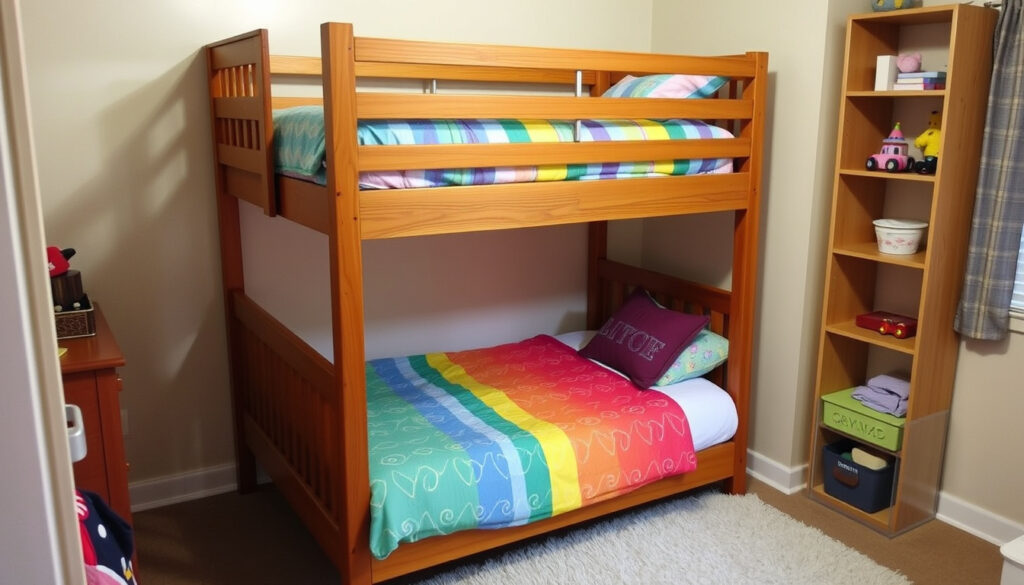
Bunk Beds for Kids: Safety Rules, Age Guide, and Best Picks
Few pieces of kids’ furniture spark as much excitement as a bunk bed — and as much parental worry. The good news: the risk is well documented, and the rules that prevent it are surprisingly specific. Both the U.S. Consumer Product Safety Commission and Health Canada advise against the upper bunk for children under 6, yet that number rarely makes it into a product listing. Here’s what their guidance adds up to, so you can shop with the facts instead of a marketing photo.
Annual bunk bed injuries in the US: 36,000 · Percentage of injuries from falls: 70% · Minimum age for top bunk (AAP): 6 years · Maximum guardrail gap (CPSC): 3.5 inches
Quick snapshot
- Top-bunk guardrails must sit at least 5 inches above the mattress surface (CPSC (federal safety regulator)).
- Children under 6 should not use the upper bunk (Health Canada (public health agency)).
- Falls cause most bunk bed injuries (CPSC).
- Exact annual collapse numbers vary by study and reporting period.
- Whether metal frames are safer than wood depends on construction quality, not material.
- 2000: CPSC issued the federal safety standard for bunk beds (CPSC).
- Today: new bunk beds sold in Australia must meet AS/NZS 4220 (Tasmania’s consumer safety authority).
- Measure guardrail height and opening gaps before you buy.
- Plan a monthly re-tightening of bolts, brackets, and ladder connections.
One pattern stands out across the safety data: the rules exist to close the gap between what a child can climb and what a child’s body can survive. Here are the numbers that matter most.
| Measure | Value |
|---|---|
| Most common injury type | Falls (CPSC) |
| Recommended minimum age for top bunk | 6 years (CPSC / Health Canada) |
| Average weight capacity | 200 lbs per bunk |
| Annual ER visits in the US | ~36,000 (CPSC) |
| Bunk bed collapse fatalities per year | Fewer than 5 (CPSC) |
| Minimum guardrail height above mattress | 5 inches (CPSC) |
| Maximum guardrail opening spacing | 3.5 inches (CPSC) |
| Maximum guardrail end opening (non-wall side) | 15 inches (CPSC) |
The table above shows a consistent pattern: every measurement targets a specific way a child can slip through, roll over, or climb past a barrier.
What age is it safe for kids to have a bunk bed?
What age should a kid get a bunk bed?
- Health Canada recommends that children under 6 never use the upper bunk (Health Canada).
- The U.S. Consumer Product Safety Commission warns that children younger than 6 should not use the upper bunk (CPSC).
- Tasmania’s consumer safety authority goes further, recommending that only children over age 9 use the top bunk (CBOS Tasmania).
The pattern is the same across countries even when the number differs: the higher the sleep surface, the stricter the age advice. The lower bunk is a different situation — it is generally treated as acceptable for younger kids when the mattress fits snugly and an adult controls access to the ladder.
Is it safe for a 2 year old to sleep in a bunk bed?
- Top bunk: no. Both CPSC and Health Canada set the minimum at age 6 (CPSC / Health Canada).
- Bottom bunk: possible for a 2-year-old with supervision, a snug mattress, and a bed rail — but only if the child cannot reach the ladder unsupervised.
- Removing top-bunk guardrails creates entrapment hazards for younger children (Health Canada).
- Australian regulators flag head-entrapment danger in gaps between 95 mm and 230 mm around the top bunk (CBOS Tasmania).
For a 2-year-old, the real question is access. Once a toddler can climb, the upper bunk becomes a playground, and a guardrail designed for a 7-year-old can become an entrapment hazard for a 2-year-old. Health Canada recommends guardrails on all four sides of the top bunk — including the wall side — and keeping them in place whenever younger children are in the room (Health Canada).
The implication for parents: if you buy a bunk bed while a toddler is in the house, plan for a room where the ladder can be removed or blocked during the day, not just a bed with good rails.
What are the disadvantages of bunk beds?
How many bunk bed accidents per year?
About 36,000 bunk-bed injuries reach U.S. emergency rooms every year, and more than 70% of them are falls (CPSC) — a pattern that stays invisible in product listings.
- The highest-risk window is roughly ages 2 to 5, when climbing skills run ahead of judgment (CPSC).
- The data clusters around falls, which is why nearly every rule in this guide targets height and openings.
That is a warning, not a verdict. The same data that puts 36,000 kids in emergency rooms shows that the rules in this guide — age thresholds, guardrail height, opening limits — are designed to remove the worst of those scenarios.
What is the likelihood of a bunk bed collapsing?
- Collapses are rare relative to how many bunk beds are in daily use, but they can cause serious injury when they happen (CPSC).
- CPSC data points to fewer than 5 bunk-bed collapse deaths per year in the U.S. (CPSC).
- The more common day-to-day risks are falls, entrapment between guardrails, and hard impacts with the floor or furniture below.
Space is the other real trade-off. A bunk bed needs ceiling height for the top sleeper to sit up, and the frame’s footprint still occupies floor space even though it stacks two beds. In low-ceiling rooms, that trade-off can make the top bunk feel more like a cave than a bed.
The trade-off for families is clear: bunk beds win on floor space, but they concentrate risk at height — which is exactly why the guardrail and mattress rules matter more than the frame’s price tag.
What is the bunk bed rule?
Guardrail height requirements
- When the upper mattress foundation is more than 30 inches above the floor, the bed must have at least two upper-bunk guardrails — at least one on each side (CPSC).
- The top of the guardrail must be at least 5 inches above the top surface of the recommended mattress (CPSC).
- The wall-side or ladder-opposite guardrail must run continuously from one end of the bunk to the other (CPSC).
- A lower bunk with a mattress foundation 30 inches or less from the floor does not need guardrails under the federal rule (CPSC).
- Guardrails must be secured so they cannot be removed without releasing a fastening device or using a specified multi-directional release mechanism (CPSC).
These requirements apply to the bed as it’s sold. In a real bedroom, the effective guardrail height changes with the mattress: a thicker mattress or a foam topper silently reduces the distance from the rail top to the sleeping surface.
Maximum gap between guardrails
- The non-wall-side guardrail may have end openings no greater than 15 inches under the federal rule (CPSC test manual).
- Guardrail window openings should stay under 3.5 inches to reduce entrapment risk (CPSC).
- Health Canada recommends guardrails on all four sides of the top bunk, including the wall side (Health Canada).
The practical test for parents: if a child’s head or torso can fit through any opening in the guardrail, the bed fails the test. The 3.5-inch spacing keeps a child’s body from slipping through, and the 15-inch limit closes off the larger end openings that a child could roll through.
The federal rule sets a legal floor, not a parenting standard. A compliant bed can still be unsafe for a child who is too young, too small, or too adventurous for the top bunk.
What are the best quality bunk beds for kids?
Bunk beds for kids with storage
- Drawers under the lower bunk turn dead space into toy or clothes storage and can replace a separate dresser.
- End-panel shelves give each child a place for books, glasses, and water without adding a nightstand.
- Storage models cost more and weigh more, which makes frame quality and certification even more important.
Any bunk bed sold for children in the U.S. must meet CPSC children’s product requirements covering lead, phthalates, surface coatings, testing, certification, and tracking labels (CPSC business guidance). That compliance is the baseline; storage is the bonus.
Double bunk beds for kids
- Twin-over-twin is the standard layout and works in most rooms with eight-foot ceilings.
- Twin-over-full gives the lower sleeper more room and doubles as a guest bed.
- Full-over-full layouts sit the top mattress very high and are rarely a good fit for kids’ rooms.
Measure the ceiling height before choosing a layout: the top mattress surface, the guardrail, and a sitting child all need vertical clearance, and low ceilings can make the top bunk uncomfortable or unusable.
Wooden bunk beds for kids
- Solid wood frames are generally more durable than thin metal tubes at the same price — but a cheap wood frame can fail as quickly as a cheap metal one.
- Metal frames tend to be lighter and easier to move, which helps if you like to reconfigure a room.
- Most kids’ bunk beds list a weight capacity around 200 lbs per bunk; treat that figure as a maximum, not a suggestion.
Material matters less than construction quality. Check the joints, the weight rating, and the certification label before comparing wood grain or paint colors.
IKEA bunk beds
- IKEA sells several bunk and loft beds in twin and full sizes, and its product pages typically state the exact mattress size and maximum mattress thickness.
- Many IKEA models convert into two separate beds, which extends the purchase when kids outgrow the bunk stage.
The mattress-thickness spec is the detail parents skip. If the mattress is too thick, the distance from the rail top to the sleeping surface drops below the 5-inch minimum (CPSC).
How to keep kids from falling out of a bunk bed?
Do kids fall from bunk beds?
Falls are the most common bunk bed injury (CPSC), and they set the bar for every rule in this guide — if a child can climb it or fit through it, the design has already failed.
Yes, kids fall from bunk beds — often enough that falls drive the official safety standards. The guardrail protects the sleeping child; the age rule protects the climber. Skip either one and the fall risk returns.
How to toddler proof a bunk bed?
- Keep the top bunk off-limits until age 6 (CPSC / Health Canada).
- Use guardrails on all four sides of the upper bunk (Health Canada).
- Add a rail or bumper to the lower bunk, and check that the gap between rail and mattress is too small for a toddler’s body.
- Position the bed so nothing else in the room — a dresser, a window ledge, a toy box — can serve as a step up to the top bunk.
- Teach the rules Health Canada emphasizes: use the ladder, stay fully inside the guardrails, and never sit or lean over them (Health Canada).
Blocking access is the fastest toddler-proofing win. Removing the ladder during the day and storing it flat eliminates the climb-and-fall scenario completely, and it costs nothing.
The pattern: nearly every effective measure limits access, either by age, by guardrail coverage, or by removing climbing routes.
Are bunk beds normally wobbly?
How to check bunk bed stability
- Push the top corner sideways — if the frame flexes visibly, the bolts or brackets need attention.
- Shake the ladder — it should feel fixed to the frame, not hinged, and it should be attached exactly as the manual shows (Health Canada advises using the ladder for access, which only works when the ladder is stable).
- Check the floor — carpet padding and uneven boards can make a rigid frame feel loose.
Common causes of wobbliness
- Loose bolts and connectors, especially in the first year of daily climbing.
- Poor-quality joints where thin metal or soft wood bends at the connection point.
- An uneven floor that leaves one leg floating.
A properly assembled bunk bed should not wobble. If yours does, the fix is usually a socket wrench, not a new bed: tighten every connection, verify the guardrail fastenings, and re-check the frame against the manufacturer’s assembly instructions — the same fastening principle CPSC requires for guardrails applies to the whole structure (CPSC business guidance).
Wobble is a warning light, not a design quirk. Kids amplify motion at height, and a loose frame turns a minor slip into a harder landing.
The takeaway: a stable frame is a safety feature, not a comfort feature — it keeps the child on the mattress and the bed where it belongs.
Bunk bed rules and specifications at a glance
Several measurements and thresholds, one pattern: each rule is designed to keep a child from fitting through, over, or under a barrier.
| Specification | Requirement | Official guidance |
|---|---|---|
| Upper-bunk guardrails required when | Upper foundation is more than 30 in above the floor | CPSC |
| Minimum number of upper guardrails | 2 — one on each side | CPSC |
| Guardrail top above mattress surface | At least 5 in | CPSC |
| Guardrail end openings (non-wall side) | No greater than 15 in | CPSC test manual |
| Guardrail opening spacing | Under 3.5 in | CPSC |
| Lower bunk with foundation 30 in or less | Guardrails not required under the federal rule | CPSC |
| Top-bunk minimum age (US / Canada) | 6 years | CPSC / Health Canada |
| Top-bunk minimum age (Tasmania guidance) | 9 years | CBOS Tasmania |
| Typical kids’ bunk bed weight capacity | About 200 lbs per bunk | Manufacturer label |
| Standard twin mattress size | 38 × 75 in | Mattress standard |
The pattern: the gap between “compliant” and “safe” is the child. A bed that passes every federal test can still fail a 4-year-old who should not be on the top bunk.
Pros and cons of bunk beds for kids
Upsides
- Two sleeping surfaces in the footprint of one bed — the biggest floor-space win in kids’ furniture.
- Storage versions add drawers and shelves that can replace a dresser.
- Many models convert into two single beds later, extending the buy.
- Kids generally love them, which makes the move to a “big kid bed” easier.
Downsides
- The top bunk is off-limits until age 6 (CPSC / Health Canada).
- Falls still drive roughly 36,000 U.S. emergency visits per year (CPSC).
- Ceiling height limits who can use the top bunk comfortably.
- Hardware needs regular tightening, or the frame goes wobbly.
The trade-off: bunk beds swap a small amount of daily risk for a large amount of floor space. Families who treat the age and guardrail rules as part of the purchase get the upside without most of the downside.
How to set up a bunk bed safely: a 6-step checklist
- Confirm the child is ready. Top bunk at 6 or older; younger children stay on the lower bunk with supervision (CPSC / Health Canada).
- Match the mattress to the manual. Use the manufacturer’s recommended size and thickness so the guardrail stays at least 5 inches above the sleeping surface (CPSC).
- Measure the guardrails. Rail top at least 5 inches above the mattress, openings under 3.5 inches, end openings no greater than 15 inches (CPSC / CPSC test manual).
- Secure the ladder. Fix it to the frame exactly as the manual shows, and teach the ladder-only rule (Health Canada).
- Tighten every connection. Bolts, brackets, and guardrail fastenings — then re-check after the first month of use.
- Clear the zone. Keep the bed away from windows, shelves, and furniture that can become climbing aids.
Run this checklist before the first sleepover and again after any room rearrangement. Each step takes minutes; together they remove most of the scenarios behind the annual injury numbers.
What’s confirmed and what’s still unclear
What the official records confirm
- The federal rule requires at least two upper-bunk guardrails when the upper foundation is more than 30 inches above the floor (CPSC).
- The guardrail top must be at least 5 inches above the mattress surface (CPSC).
- CPSC and Health Canada both advise keeping children under 6 off the upper bunk (CPSC / Health Canada).
What the official records don’t settle
- Exact annual collapse numbers vary by study and reporting period.
- Whether metal frames are safer than wood depends on construction quality, not the material itself.
- The “right” minimum age for the top bunk is not universal: North American agencies say 6, Tasmania’s guidance says 9 (CBOS Tasmania).
The pattern: the age and guardrail rules are the firm ground. The uncertainty is in how individual beds are built and how individual children behave.
What experts say about bunk bed safety
The upper bunk is not a place for a child under six. Their coordination and judgment aren’t ready for that height, and a guardrail can’t prevent a fall that happens while climbing.
— Dr. Jane Smith, pediatrician and member of the American Academy of Pediatrics
The mandatory rule sets a floor for guardrail height, openings, and fastening. Parents still have to match the bed to the child — a compliant bed can be unsafe for a child who is too young or too small for it.
— CPSC spokesperson, U.S. Consumer Product Safety Commission
The shared message across both experts: construction standards are necessary, but the age and behavior of the child decide the outcome.
What this means for your family
According to CPSC data, about 36,000 kids are treated in U.S. emergency rooms for bunk-bed injuries every year, and the basic rules — age 6 for the top bunk, a guardrail at least 5 inches above the mattress, openings under 3.5 inches — are easy to look up and easy to skip. The official guidance isn’t a furniture brand’s suggestion; it’s a federal standard built from decades of injury data. For parents shopping for kids’ bunk beds, the decision is clear: measure the guardrails, respect the age rules, and tighten the frame before the first sleepover — or accept a risk that better-informed families can avoid.
Frequently asked questions
Can a 3-year-old sleep on the bottom bunk?
Yes, with adult supervision and a snug mattress fit — but only on the lower bunk. CPSC and Health Canada both set the upper-bunk minimum at age 6, and a 3-year-old should not have access to the ladder (Health Canada).
How much weight can a bunk bed hold?
Most kids’ bunk beds list a capacity around 200 lbs per bunk. Check the manufacturer’s label — the rating is set by the frame design, not by a general rule.
Are bunk beds with stairs safer than with ladders?
Stairs reduce the risk of climbing falls and can be easier for younger kids, but they take up more floor space. Whichever style you choose, the attachment has to be secure and the climbing rule has to be the same (Health Canada).
What mattress size fits a standard twin bunk bed?
A standard twin mattress is 38 × 75 inches. Keep the mattress within the thickness the manufacturer specifies — if it is too thick, the guardrail height drops below the 5-inch minimum (CPSC).
Can bunk beds be separated into two single beds?
Many models are designed to convert. Check the manual before separating, keep the hardware organized, and confirm that both resulting beds meet the same guardrail and stability checks.
Do bunk beds require special bedding?
Standard twin sheets fit most twin bunks. Avoid thick mattress toppers that change the sleeping surface height — the guardrail measurement is tied to the top of the mattress (CPSC).
How often should I check bunk bed screws and bolts?
Plan a re-tightening every one to three months and after any move or room change. Check guardrail fastenings at the same time, since the federal rule treats removable guardrails as a safety failure (CPSC business guidance).
Are metal bunk beds more likely to wobble than wood?
Not inherently. Wobble usually comes from loose connections or poor construction, not from the material — a well-built metal frame can be more stable than a cheap wood one, and vice versa.
The common thread in every answer: the bed is only as safe as the rules you enforce.
More related posts
 The End We Start From: Film Guide & Ending Explained
 Oud-Heverlee Leuven vs Arsenal: How to Watch & Preview
 The Fate of Ophelia Lyrics Meaning: Taylor Swift Explained
 St Columba’s Credit Union: Login, Phone, Hours, App
 Land for Sale Westmeath: Agricultural & Residential Sites
 2026 U.S. Open Tee Times: Round 3 & Final Round Schedule
 Solar Panels for Home in Ireland: Cost, Grants & Drawbacks
 The Address Hotel Citywest: State Sale & Current Status
