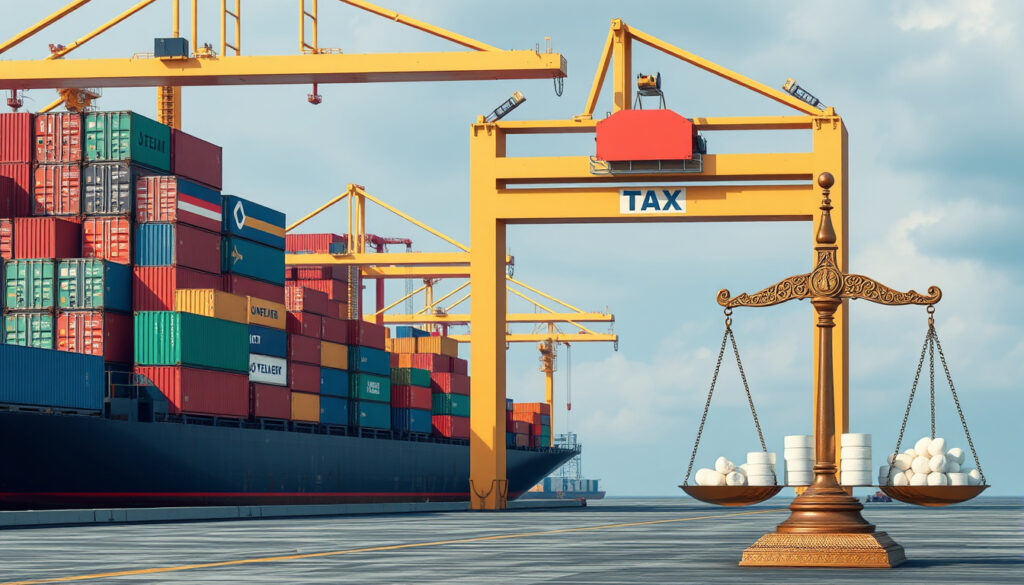
How Do Tariffs Work? A Simple Guide and Examples
Anyone who has ever checked the price tag on an imported product and wondered why it costs more than it should has already met the invisible hand of a tariff. They are one of the oldest tools in the economic policy kit, a simple tax on foreign goods that reshapes prices, politics, and trade — and this guide breaks down how tariffs work, who really foots the bill, and what recent U.S. tariff policy means for your wallet, using current research from the New York Fed and other sources.
Example tariff calculation: 10% tariff on a $10 product adds $1 ·
Money recipient: Importing government ·
Primary purpose: Protect domestic industry and raise revenue
Quick snapshot
- A tariff is a tax on imported goods that makes foreign products more expensive (Britannica (encyclopedia))
- The importing company pays the tariff at the border, and often passes it on to consumers (Britannica (encyclopedia))
- Nearly 90% of the economic burden of the 2025 U.S. tariffs fell on U.S. firms and consumers (New York Fed Liberty Street Economics (research))
- The long-term net effect on the U.S. economy remains uncertain
- Whether tariffs achieve their intended policy goals is disputed
- The precise degree of tariff cost pass-through to consumers varies
- 2018: Trump imposes 25% steel and 10% aluminum tariffs (NPR (public radio))
- 2025: New tariffs proposed, including up to 60% on Chinese goods (BBC (public broadcaster))
- 2026: CBO projects tariffs will reduce deficits by $2.8 trillion over 10 years (Reuters (news agency))
- Watch for potential GDP impact projected at 0.54% in 2025, rising to 1.86% in 2027 (Council on Foreign Relations (policy research))
- Inflation could rise 0.4 percentage points in 2025-2026 per CBO projections (Associated Press (news))
The table below sums up the core facts about tariffs in one glance:
| Key fact | Details |
|---|---|
| Definition | Tax on imported goods |
| U.S. average tariff rate | ~2.5% (pre-Trump) |
| Recent example | Trump’s 25% steel tariff (2018) |
| Revenue generated | Billions of dollars annually |
How do tariffs work in simple terms?
Definition of a tariff
- A tariff is a tax on imported goods that makes foreign products more expensive (Britannica (encyclopedia))
- Tariffs are commonly used to protect domestic industries by raising the price of imports (Britannica (encyclopedia))
- They can also generate revenue for the government that imposes them (Britannica (encyclopedia))
Think of a tariff like a toll booth on a bridge. When a truck full of foreign goods arrives, the government charges a fee to let those goods cross into the country. That fee is the tariff. It’s designed to make imported goods more expensive so domestic products have a competitive edge.
How tariffs are calculated
There are two main ways tariffs are calculated, and they follow a simple logic that determines how much extra you might pay. They can be ad valorem (a percentage of the product’s value) or specific (a fixed amount per unit), but the ad valorem method is most common for consumer goods.
For example, a 10% tariff on a $10 product makes it $11 when it enters the market. This calculation seems simple, but the real-world application involves complex valuation rules at customs.
The pattern is clear: even a modest tariff changes the price consumers see, and that price change is the whole point of the policy.
Who actually pays an import tariff?
Who pays the tariff at the border
The answer to “who pays tariffs” is more nuanced than it seems. In practice, the company importing the foreign product usually pays the tariff at the border (Britannica (encyclopedia)). This means the importer writes the check to customs, but that’s not the end of the story.
The importing company is the one paying the government, but the real question is who ultimately shoulders the burden. NPR reports that U.S. importers are primarily responsible for the tariff tax burden, even though some of the cost is passed to consumers (NPR (public radio)).
Pass-through to consumers
Importers often pass some or all of the tariff cost into higher consumer prices (Britannica (encyclopedia)). The New York Fed found that nearly 90 percent of the economic burden of the 2025 U.S. tariffs fell on U.S. firms and consumers (New York Fed Liberty Street Economics (research)).
How much actually gets passed along? Estimates vary. Reuters reported the Brookings analysis estimated tariff-inclusive price pass-through at 80 percent to 100 percent (Reuters (news agency)). Meanwhile, BBC reported Goldman Sachs estimated about 55 percent of the new tariffs were passed to consumers last year (BBC (public broadcaster)).
Government revenue from tariffs
The government that imposes the tariff collects the revenue. Tariffs can generate significant income. In fact, AP reported the Congressional Budget Office projected Trump’s tariffs would reduce federal deficits by $2.8 trillion over ten years (Associated Press (news)).
While tariff revenue flows to the government, consumers feel the pinch. The trade-off is stark: deficit reduction comes at the cost of higher prices at checkout, and the Federal Reserve noted that tariff incidence is borne mainly domestically rather than by foreign exporters (New York Fed).
The implication here is clear: the person who “pays” the tariff in the formal sense is the importer, but the economic burden is shared broadly across American households and businesses, not by the foreign countries whose goods are being taxed.
Why does Trump want tariffs?
Reasons for Trump’s tariffs
Trump’s tariff policy has been a signature economic initiative. The stated reasons for these tariffs include protecting domestic industries, reducing the trade deficit, and creating negotiating leverage. Tariffs are commonly used to protect domestic industries by raising the price of imports (Britannica (encyclopedia)), and this logic underpins much of the administration’s approach.
However, the economic rationale has been questioned by multiple analyses. The Council on Foreign Relations said tariffs can reduce GDP by raising costs, triggering retaliation, and reallocating resources toward less efficient firms (Council on Foreign Relations (policy research)).
Impact on U.S. economy
The measured effects so far are mixed but increasingly concerning for growth. CFR projected cumulative U.S. GDP losses from tariffs of 0.54 percent in 2025, 1.76 percent in 2026, 1.86 percent in 2027, and 1.53 percent in 2028 (Council on Foreign Relations (policy research)).
Reuters summarized a Brookings analysis as finding the immediate welfare impact of Trump’s 2025 tariffs ranged from a 0.1 percent gain to a 0.13 percent GDP loss depending on assumptions (Reuters (news agency)). The cumulative loss of U.S. economic output could reach about $1.4 trillion by the end of 2028 (Council on Foreign Relations (policy research)).
The implication is that tariff policy, whatever its political appeal, carries a measurable economic price that the administration must weigh against its stated goals.
What is a good example of a tariff?
Example of a specific tariff
Let’s walk through a concrete example to make this tangible. Imagine a $10 product imported from overseas. If the U.S. imposes a 10% tariff on that product, the importer must pay an additional $1 to the government at the border. The product’s cost rises to $11 before any retail markup. This is the classic ad valorem tariff structure (Britannica (encyclopedia)).
For a real-world example, look at Trump’s 2018 tariffs: 25% on steel and 10% on aluminum. These were designed to protect American steel and aluminum producers from international competition, but they raised input costs for manufacturers using those materials.
How the tariff changes price
Tariffs can be ad valorem (a percentage of the value) or specific (a fixed amount per unit). The ad valorem tariff is most common for consumer goods. With a 25% steel tariff, a $1,000 steel shipment would cost $1,250 to import, and that extra cost often shows up in the price of cars, appliances, and construction materials.
The tariff example illustrates a larger pattern: the cost of protectionism is rarely an abstract concept. It shows up in the prices consumers pay for everyday goods—from a $10 product becoming $11, to a new car costing hundreds more because of steel tariffs.
The trade-off here is that domestic producers might benefit from less competition, but the broader economy often loses more than it gains, as the CFR projections suggest.
How do tariffs affect the economy?
Effect on consumers
The most direct effect is on consumer prices. AP reported the CBO expected the tariffs to raise the annual inflation rate by 0.4 percentage points during 2025 and 2026 (Associated Press (news)). BBC reported those tariffs contributed about 0.5 percentage points to U.S. inflation (BBC (public broadcaster)).
For a typical family, this means higher prices on everything from electronics to clothing. The New York Fed’s finding that nearly 90 percent of the tariff burden falls on domestic firms and consumers underscores how difficult it is for importers to shift costs to foreign exporters (New York Fed Liberty Street Economics (research)).
Effect on businesses
Businesses face two pressures: higher input costs and potential retaliation in foreign markets. The Council on Foreign Relations said tariffs can reduce GDP by raising costs, triggering retaliation, and reallocating resources toward less efficient firms (Council on Foreign Relations (policy research)).
Businesses that rely on imported components—from auto parts to computer chips—must either absorb the costs, pass them on, or find new suppliers. Each option carries risk, especially for small businesses that lack the leverage of larger corporations.
Who benefits
Some domestic producers benefit from reduced competition. Tariffs raise the price of foreign goods, making domestic products relatively more attractive. This is the intended protective effect that proponents cite (Britannica (encyclopedia)).
However, the overall economic impact can be negative. AP reported the CBO expected Trump’s tariffs to reduce GDP growth by 0.06 percentage points annually (Associated Press (news)). At the same time, the deficit reduction effect is significant, creating a complicated fiscal situation.
The pattern is that tariffs create winners and losers, and the losing side — consumers and businesses that rely on imports — tends to outweigh the protected industries.
Pros and cons of tariffs
Here’s how the main arguments stack up against the data:
| Perspective | What the data says |
|---|---|
| Government revenue | Tariffs raise funds; CBO projects $2.8 trillion in deficit reduction over 10 years |
| Domestic industry | Protected from foreign competition; steel and aluminum producers benefited in 2018 |
| Consumers | Face higher prices; 0.4-0.5 percentage point inflation increase |
| GDP growth | Reduced by 0.06-1.86% depending on year and model |
Upsides
- Generates government revenue (Britannica)
- Protects domestic industries from foreign competition (Britannica)
- Can be used as negotiating leverage in trade talks
Downsides
- Raises prices for consumers; nearly 90% of burden falls on U.S. firms and households (New York Fed)
- Can reduce GDP and trigger retaliation (CFR)
- Creates economic inefficiencies by reallocating resources to less competitive firms (CFR)
The catch is that the benefits of tariffs are concentrated in a few protected industries, while the costs are spread across millions of consumers.
Timeline of recent U.S. tariff actions
Five milestones, one pattern: tariffs escalate quickly, but their economic consequences unfold over years.
| Year | Event |
|---|---|
| 2018 | Trump imposes 25% tariff on steel and 10% on aluminum |
| 2019 | Escalation of trade war with China; tariffs on $250 billion of Chinese goods |
| 2020 | USMCA agreement replaces NAFTA; some tariffs remain |
| 2024 | Biden administration maintains many Trump-era tariffs |
| 2025 | Trump proposes new tariffs (up to 60% on Chinese goods) |
What this means: the timeline shows that tariffs rarely get fully removed once enacted. Each administration has kept or expanded the previous one’s trade barriers, suggesting tariffs have become a structural feature of U.S. trade policy rather than a temporary measure.
What’s confirmed and what’s not
Confirmed facts
- Tariffs are taxes on imports (Britannica)
- Paid by importing companies (Britannica)
- Revenue collected by government (Britannica)
- Often passed to consumers (Britannica)
- Nearly 90% of 2025 tariff burden fell on U.S. firms and consumers (New York Fed)
What remains unclear
- Long-term net effect on U.S. economy
- Whether tariffs achieve intended goals
- Precise degree of pass-through to consumer prices
Even with strong evidence that tariffs raise prices and reduce GDP, the exact magnitude of effects varies by model and timeframe. What’s less disputed is that the burden falls mostly on domestic actors, not foreign exporters.
What experts are saying
“Tariffs can reduce GDP by raising costs, triggering retaliation, and reallocating resources toward less efficient firms.”
Council on Foreign Relations
“Nearly 90 percent of the economic burden of the 2025 U.S. tariffs fell on U.S. firms and consumers.”
New York Fed Liberty Street Economics
“Tariffs are commonly used to protect domestic industries by raising the price of imports.”
Britannica
These perspectives span institutional research (New York Fed), policy analysis (CFR), and foundational reference material (Britannica), offering different lenses on the same reality: tariffs are a tax that mostly stays at home.
Summary: The tariff trade-off
The evidence is clear: tariffs are a tax on imports that raises prices for consumers, generates government revenue, and provides uneven protection for domestic industries. The recent U.S. experience shows the burden falls heavily on American households—nearly 90% of the 2025 tariff costs stayed in the U.S. (New York Fed). For the average consumer, the choice is stark: pay higher prices for imported goods, or shift spending to domestic alternatives that may not offer the same value. For policymakers in Washington, the decision is equally pointed: pursue tariffs as a revenue tool and accept the GDP drag and inflation they bring, or seek alternative trade policies that don’t tax the very households they represent. Either way, policymakers must choose: accept the GDP drag and inflation that tariffs bring, or find alternatives that don’t tax the households they represent.
nytimes.com, piie.com, reuters.com, npr.org, theguardian.com
Frequently asked questions
How do tariffs affect small businesses?
Small businesses often feel tariff impacts most acutely because they lack the supply chain flexibility of large corporations. When input costs rise, they must either absorb the margin hit or raise prices, often losing customers to bigger competitors who can absorb the cost. Tariffs increase the cost of imported components and goods, which disproportionately affects smaller firms that rely on imported materials.
Are tariffs the same as taxes?
Yes, essentially. A tariff is a specific type of tax imposed on imported goods. It is collected at the border by customs officials from the importing company. Unlike income or sales taxes, tariffs are specifically designed to affect international trade flows and can serve dual purposes: raising revenue and protecting domestic industries.
Can tariffs be avoided?
In some cases, companies can minimize tariff exposure through strategies like shifting supply chains to countries without tariffs, using free trade agreements, or reclassifying goods. However, these strategies have limits. The New York Fed found that even with such adjustments, nearly 90% of the 2025 tariff burden remained on U.S. firms and consumers.
What is the difference between a tariff and a quota?
A tariff is a tax on imports, while a quota is a physical limit on the quantity of a good that can be imported. Tariffs generate revenue for the government, while quotas do not (unless the quota licenses are sold). Quotas are often considered more restrictive because they cap supply regardless of price.
How do retaliatory tariffs work?
When one country imposes tariffs on another’s exports, the affected country can respond with tariffs of its own. This creates a cycle where both countries’ consumers face higher prices. The Council on Foreign Relations notes that retaliation is one of the key mechanisms through which tariffs reduce GDP.
What goods are commonly subject to tariffs?
Common tariffed goods include steel, aluminum, electronics, clothing, and automobiles. The 2018 tariffs targeted steel (25%) and aluminum (10%), and the 2025 proposals target a broader range of Chinese goods, potentially up to 60% on some products.
Do tariffs cause inflation?
Tariffs directly contribute to inflation by raising the price of imported goods. The CBO projected tariffs would raise the annual inflation rate by 0.4 percentage points in 2025-2026, and BBC reported the actual contribution was around 0.5 percentage points. This means consumers see higher prices on everything from electronics to clothing.
Related reading
- Convert USD to Euro: Rates, Fees, and Best Methods — Understanding currency exchange matters when assessing how tariffs affect trade flows and exchange rates.
- Social Welfare Payment Increase Ireland 2026: Budget & Bonuses — Government budgets and revenue decisions often interact with tariff policy, affecting household incomes.
More related posts
 Cronos: The New Dawn Review: Is It Worth Playing? (2025)
 166 cm in Feet: Is It 5’5″ or 5’6″? [Complete Guide]
 BBC Football Gossip Today: Latest Transfer Rumors & Speculation
 What Time Is EastEnders On Tonight? BBC One Schedule
 What Province is Dublin In? Leinster & Ireland’s Provinces
 National Stadium Dublin Capacity
 Translate German to English: Best Free Tools & Methods
 Ashwagandha KSM-66: Benefits, Safety, and Dosage
